What is the difference between a fillable umbrella base and a solid one?
- Share
- Issue Time
- Oct 23,2026
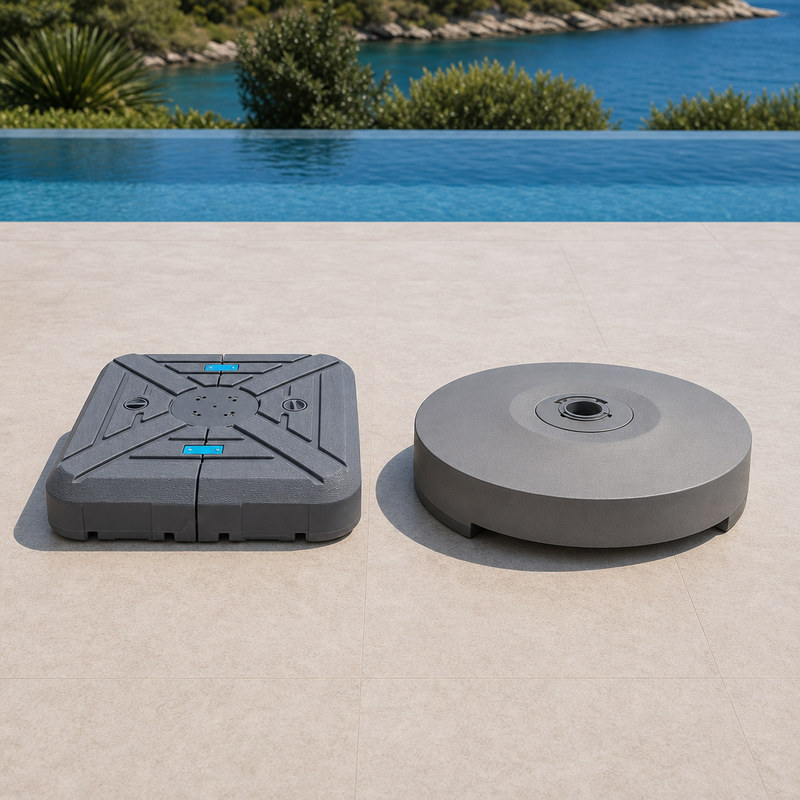
What is the difference between a fillable umbrella base and a solid one?
A fillable base ships empty and light. Our HDPE models weigh 13.6 kg and 15.5 kg before filling, then reach 60 kg, 138 kg or 180 kg once filled with water. That makes them cheaper to ship and easy for one person to carry onto a terrace, and several have built-in castors or a wheeled side so the base can be tipped and rolled into position.
A solid base ships at its working weight: resin bases from 8 kg to 19 kg, a steel-plated concrete base at 45 kg, modular steel plates from 55 kg to 160 kg, and a welded marble base at 360 kg. There is nothing to fill, nothing to drain, and nothing that can be left half empty by mistake.
The usual split in practice is fillable bases for terraces that get re-arranged, or where nobody will maintain a fill level, and solid bases for fixed commercial layouts where reliability matters more than shipping cost.
Fillable vs fixed bases
A fillable base ships empty and is weighted on site with water or sand, which cuts freight cost and lets one person position it. A fixed (pre-weighted) base arrives ready and is denser, but heavier to ship and move.
Decision guide
Choose fillable for volume orders and for sites where you position bases yourself. Choose fixed concrete or steel bases where theft, tampering, or maximum low-profile stability matters, such as public pools.
Either way, match the base class to the umbrella size and the local wind. A 3.0 m cantilever needs far more hold-down than a 2.0 m centre pole.