The Art of Outdoor Shade: How Luxury Hotels Use Umbrellas to Define Outdoor Spaces
- Share
- publisher
- Foris Hortus
- Issue Time
- Aug 31,2026
Summary
How luxury hotels and resorts use umbrellas to define outdoor spaces — from UV protection and thermal comfort to measurable revenue uplift — with the shade solutions that make terraces, pools, and dining areas work.
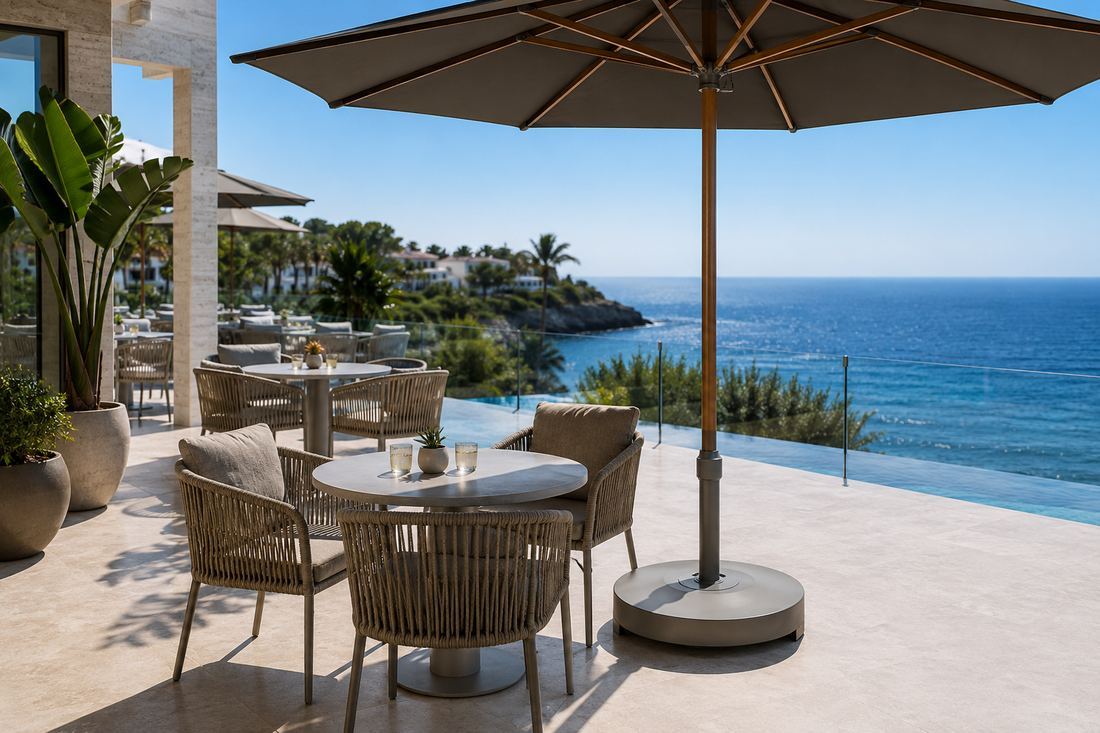
For the world's leading hotels, the most valuable square metre is no longer inside the lobby — it is the one outside it. Outdoor shade solutions have quietly become the backbone of premium hotel terrace design, turning rooftops, pool decks and garden courtyards into high-yield experiences. And the shift is not a matter of taste alone: it is backed by hard numbers on revenue, guest behaviour, UV physics and thermal comfort.
The New Lobby Is Outdoors
The post-2020 travel boom did not just bring guests back — it moved them outside. Across major markets, outdoor seating and rooftop venues are now a primary booking driver, not a seasonal extra:
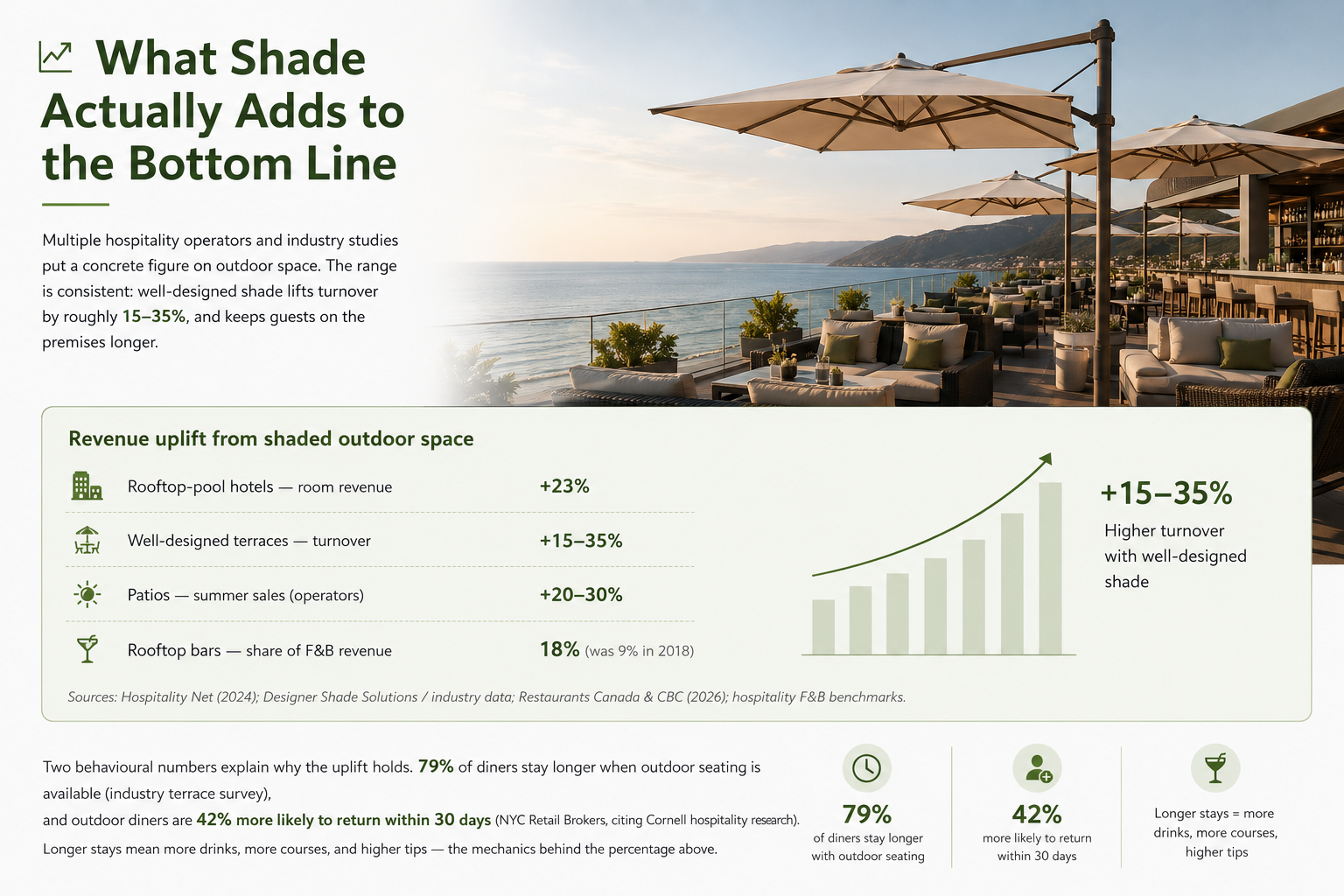
- Hotels with rooftop pools report an average 23% higher room revenue than properties without them (Hospitality Net, 2024).
- 67% of luxury hotel guests rank "view quality" as their top deciding factor when booking (J.D. Power, 2025).
- The global rooftop restaurant and bar market is projected to reach US$8.2 billion by 2026, growing at 11.3% annually (Allied Market Research).
- On online reservation platforms, outdoor dining bookings rose 24% year-over-year in Canada (OpenTable, May 2026).
For a hotel, an umbrella is never just a parasol. It is the tool that makes an open, sun-blasted deck usable — and usability is what converts square metres into revenue.
What Shade Actually Adds to the Bottom Line
Multiple hospitality operators and industry studies put a concrete figure on outdoor space. The range is consistent: well-designed shade lifts turnover by roughly 15–35%, and keeps guests on the premises longer.
Two behavioural numbers explain why the uplift holds. 79% of diners stay longer when outdoor seating is available (industry terrace survey), and outdoor diners are 42% more likely to return within 30 days (NYC Retail Brokers, citing Cornell hospitality research). Longer stays mean more drinks, more courses, and higher tips — the mechanics behind the percentage above.
The Measurable Science of UV Protection
Luxury guests increasingly expect protection, not just views. The public-health case is unambiguous and quantified:
The WHO is explicit: sun protection is recommended whenever the UV Index reaches 3 or above, which it does across most leisure destinations for much of the day. A 1998 study in the Medical Journal of Australia (Parsons et al.) — the basis for Cancer Council guidance — measured that quality shade cuts UV exposure by up to 75%. For pool decks and beach clubs, that is the difference between a comfortable stay and a liability. The practical lesson for procurement is to specify genuine UV protection umbrellas — rated, UPF-classed canopies rather than decorative shade — so the 75% reduction is real, not assumed.
How Much Cooler Does an Umbrella Make It?
"Shade feels nice" is not a strategy. The cooling effect of personal shading has been measured in the field, and the numbers are the reason hotels invest in canopies rather than leaving decks bare:
For intellectual honesty: the effect depends on the canopy. A 2026 model by Wohlfahrt (EGU General Assembly, reported in New Scientist) found a simple beach parasol can lower effective temperature by only about 1°C, because the hot fabric re-radiates longwave heat downward. The takeaway for buyers is precise: vented, reflective, UPF-rated canopies deliver the larger cooling — which is exactly what commercial-grade UV protection umbrellas are engineered for.
How Umbrellas Define Space, Not Just Cover Tables
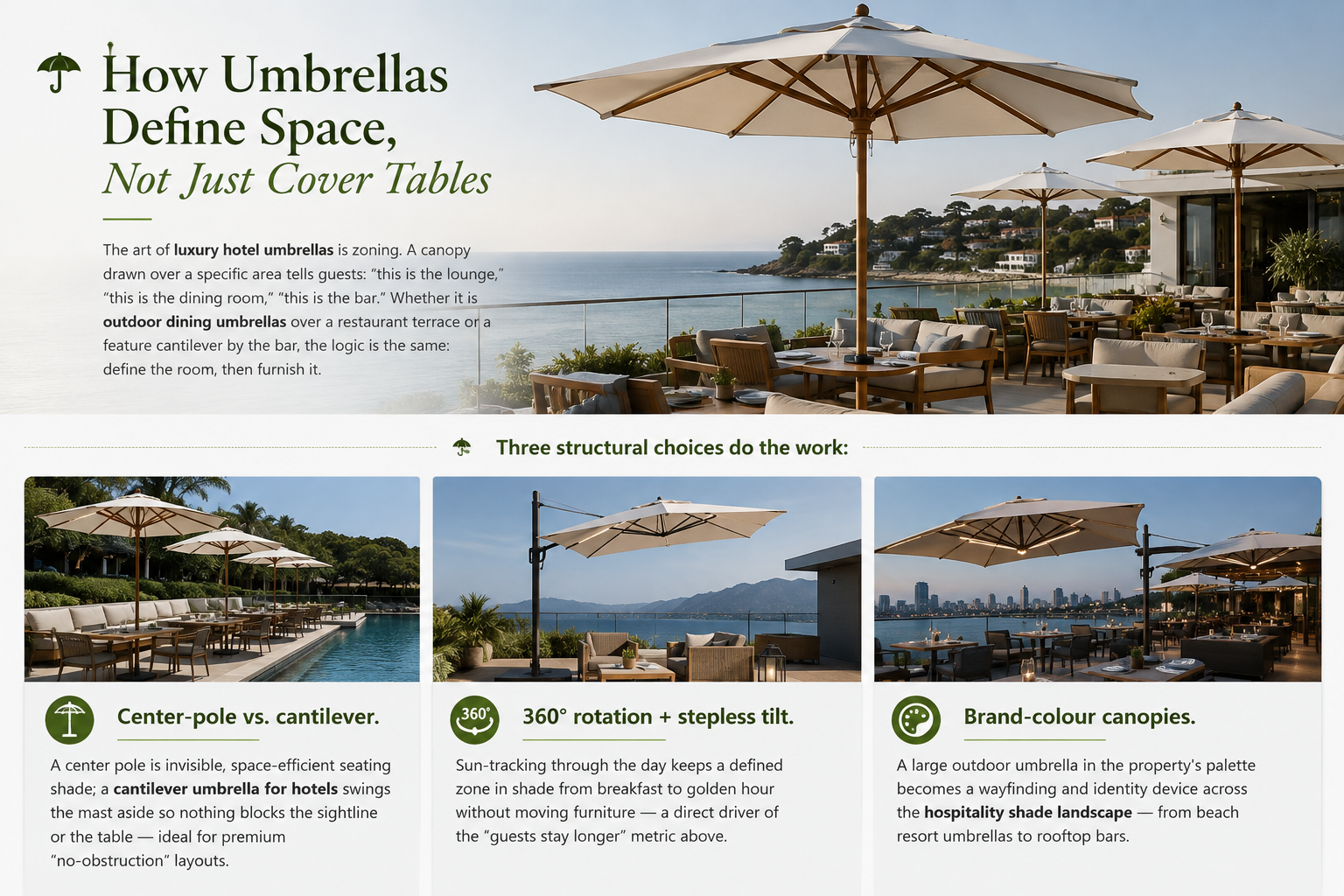
The art of luxury hotel umbrellas is zoning. A canopy drawn over a specific area tells guests: "this is the lounge," "this is the dining room," "this is the bar." Whether it is outdoor dining umbrellas over a restaurant terrace or a feature cantilever by the bar, the logic is the same: define the room, then furnish it. Three structural choices do the work:
- Center-pole vs. cantilever. A center pole is invisible, space-efficient seating shade; a cantilever umbrella for hotels swings the mast aside so nothing blocks the sightline or the table — ideal for premium "no-obstruction" layouts.
- 360° rotation + stepless tilt. Sun-tracking through the day keeps a defined zone in shade from breakfast to golden hour without moving furniture — a direct driver of the "guests stay longer" metric above.
- Brand-colour canopies. A large outdoor umbrella in the property's palette becomes a wayfinding and identity device across the hospitality shade landscape — from beach resort umbrellas to rooftop bars.
Built to Last: Wind, Materials and the Standards That Matter
A commercial patio umbrella is a structural specification, not furniture. In coastal and rooftop sites, wind is the failure mode — so the ratings are written into standards:
| Beaufort | Wind speed | Commercial meaning |
|---|---|---|
| Force 6 | 39–49 km/h (25–31 mph) | "Strong breeze" — EN 13561 Class 2 rated shade |
| Force 7 | 50–61 km/h (32–38 mph) | "Near gale" — EN 13561 Class 3; typical cantilever rating |
| Force 8+ | 62–74 km/h+ | Heavy-duty / hurricane-grade units (e.g. 100 km/h rated) |
Procurement reality, grounded in the same standards and ASTM F2612 (umbrella safety): a cantilever needs a weighted base of 100–200 kg to resist overturning, an aluminium or powder-coated frame for corrosion resistance, a double-vented canopy to release uplift, and solution-dyed acrylic rated UPF 50+. Specifying to these numbers is what keeps an umbrella open when a 35 mph gust arrives in minutes — the scenario that wrecks untested units.
A Practical Deployment Map
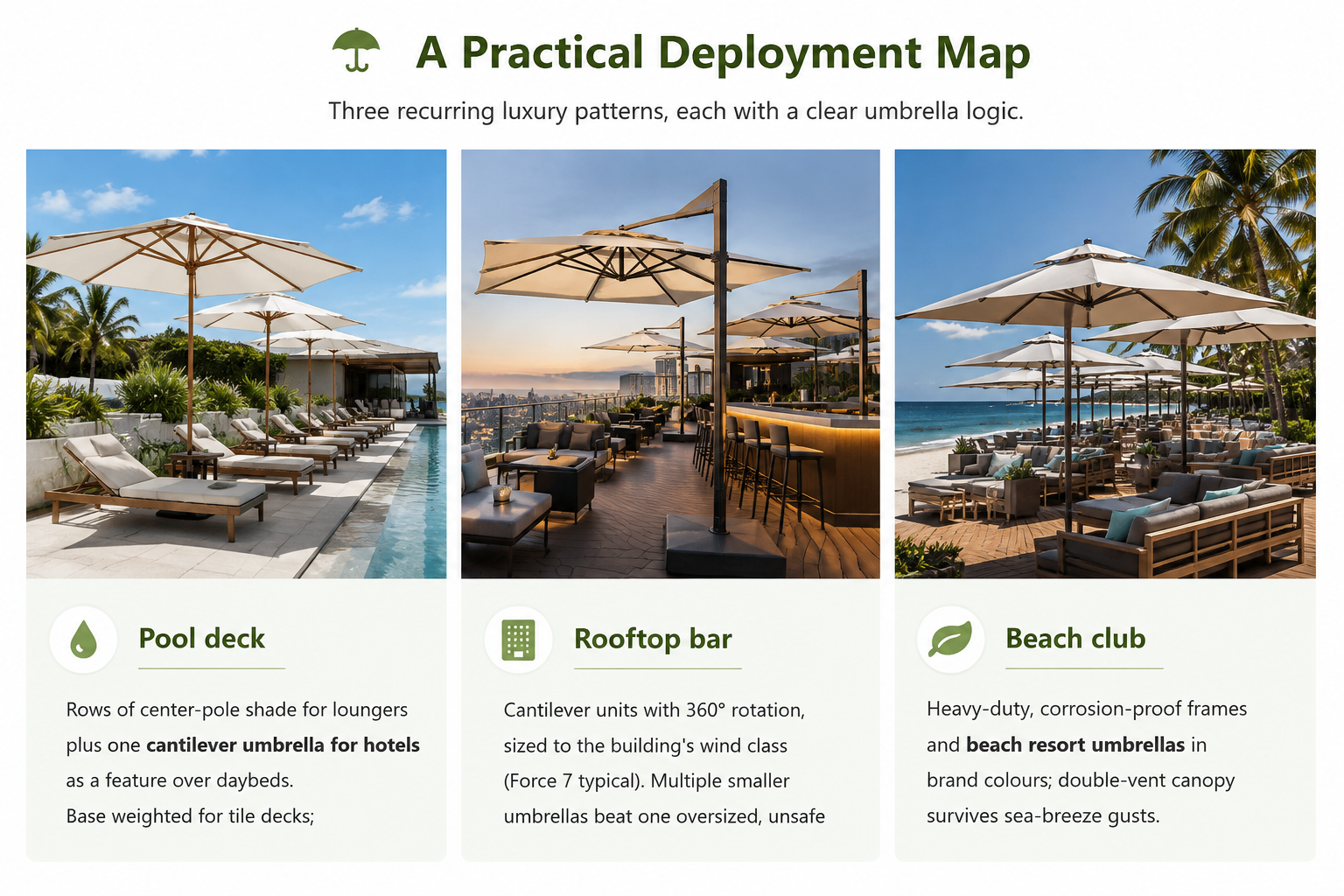
Three recurring luxury patterns, each with a clear umbrella logic:
Pool deck
Rows of center-pole shade for loungers plus one cantilever umbrella for hotels as a feature over daybeds. Base weighted for tile decks; fabric UPF 50+.
Rooftop bar
Cantilever units with 360° rotation, sized to the building's wind class (Force 7 typical). Multiple smaller umbrellas beat one oversized, unsafe unit.
Beach club
Heavy-duty, corrosion-proof frames and beach resort umbrellas in brand colours; double-vent canopy survives sea-breeze gusts.
Sources & Further Reading
World Health Organization — Ultraviolet radiation fact sheet & sun-protection Q&A (2024). Cancer Council Australia / NSW — shade & UV guidance (Parsons et al., Med. J. Aust. 1998). Li et al., Energy and Built Environment (2026). Auburn University climatologist C. Mitra field study (2026). Watanabe & Ishii, Int. J. Biometeorol. (2017). ScienceDirect UTCI parasol study (2024). Wohlfahrt, EGU General Assembly (2026). Hospitality Net (2024); J.D. Power (2025); Allied Market Research; OpenTable (2026); Restaurants Canada / CBC (2026). Archive Market Research & Data Insights Market — outdoor umbrella market sizing. EN 13561 & ASTM F2612 umbrella standards.
Design your outdoor shade with Foris Hortus
Whether you are specifying luxury hotel umbrellas for a new rooftop bar or upgrading commercial patio umbrellas across a resort, our team engineers hospitality shade to your wind class, brand palette and layout. We supply OEM and project-grade cantilever umbrellas for hotels, center-pole and large outdoor umbrellas — with UPF 50+ canopies, weighted bases and third-party wind certification.
Contact our team Send an inquiry Browse the catalog
Tell us your site, typical wind exposure and the zones you want to define — we will return a layout and a quote. No obligation, just a sharper outdoor space.