Spare Parts and Replacement Canopies: What You Can Still Buy in Year Five
- Share
- Issue Time
- Oct 6,2026
Summary
Commercial umbrellas can be kept in service with spare parts rather than replaced. This guide covers the parts that exist on a commercial umbrella, which of them wear first, how the opening mechanism you specify decides your future parts bill, what a five-year parts commitment does and does not include, how to identify a part from a model code or a photograph, how to match a replacement canopy to umbrellas already on site, and how the leading brands handle parts.
The short answer
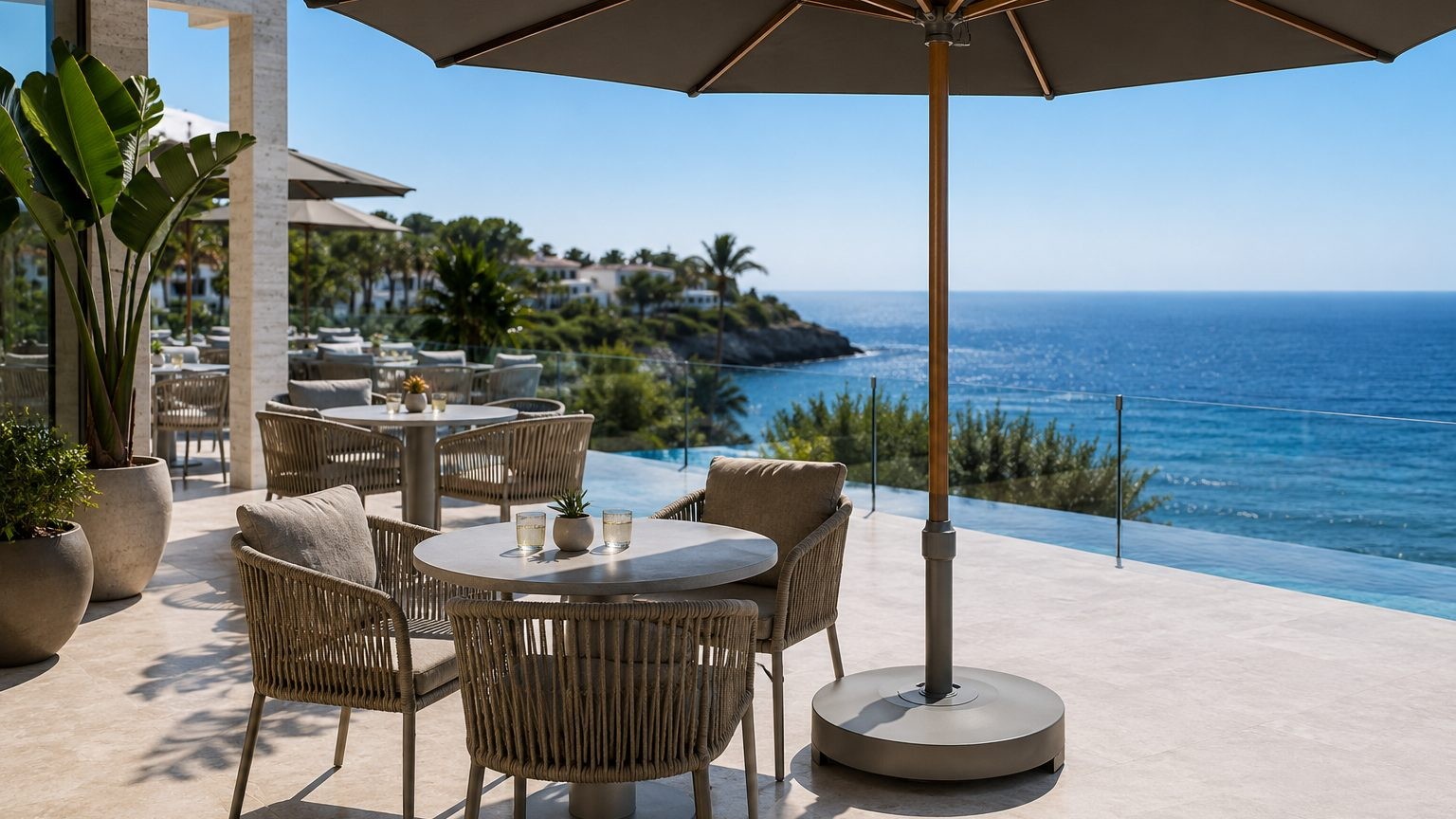
For the standard ranges, you can still buy parts five years after purchase. That covers replacement canopies made to your original size, fabric and colour, plus ribs, hubs, cranks, finials, base plates and fixing kits. We hold stock of the common parts, so most spare-parts orders ship within seven days, and we quote the same day you ask.
The longer answer is more useful than the short one, because the number of spare parts a venue ever needs is not decided in year five. It is decided at the specification stage, by the opening mechanism and the frame you choose. Two umbrellas of the same size, on the same terrace, can have very different five-year parts bills, and the difference is almost never the canopy.
This article covers what a spare part actually is on a commercial umbrella, which parts fail first, how the mechanism you specify changes the parts you will order, what the five-year commitment does and does not include, and how to order a part so it matches the umbrellas already on your site.
A spare part is not one thing
Buyers tend to talk about spare parts as a single category. In practice there are five groups, and they behave completely differently.
Fabric parts. The canopy itself, and on some models the valance that hangs from the edge. A canopy is a wear item. It takes UV, rain, pollution and cleaning, and it is the part most likely to be replaced first.
Rib and frame parts. The ribs that hold the canopy out, the hub at the top where the ribs meet, and on cantilever models the struts and the arms that carry the canopy away from the pole.
Mechanical parts. Whatever opens and closes the umbrella. On this range that is one of three systems: a push-pull mechanism, a hand crank, or a rope-and-pulley lift. These parts do the most work and are where maintenance attention belongs.
Structural parts. The pole, the pole sections on a cantilever, the connectors between them, and the brackets that tie the frame together.
Base and fixing parts. Base plates, the socket that receives the pole, and the fixing kit that ties the base to the surface.
The distinction matters because these five groups have different failure patterns, different lead times and different prices. A venue that replaces a canopy every four years and never touches the frame is in a completely different position from one that replaces a crank every second season.
The parts, in the words buyers use and the words we use
Half of the friction in a spare-parts conversation is vocabulary. Buyers describe a part by where it is and what it does; the specification names it by what it is. Both descriptions are correct, and they only become a problem when a venue asks for "the bit at the top" and receives something that fits a different model.
Here is the mapping, using the terms this range is specified in.
The canopy and the parts of the canopy
What buyers call the cover, the top or the cloth. In the specification it is the canopy, and it is the part most often replaced. On models with a hanging border, the border is the valance, and it is a separate item from the canopy itself, which matters for branding because the valance is where venue names are typically printed.
The ribs, and the hub they meet
The ribs are the arms that hold the canopy out. On this range they are specified by section, which is the measurement that identifies the correct replacement: sections run from 14.5 x 24 x 1.0mm on compact centre pole models through 20 x 30 x 1.2mm on mid-range models up to 35 x 22mm on the largest commercial frames. The count matters as much as the section: models in this range run from 8 ribs up to 12 ribs on the oversized frames.
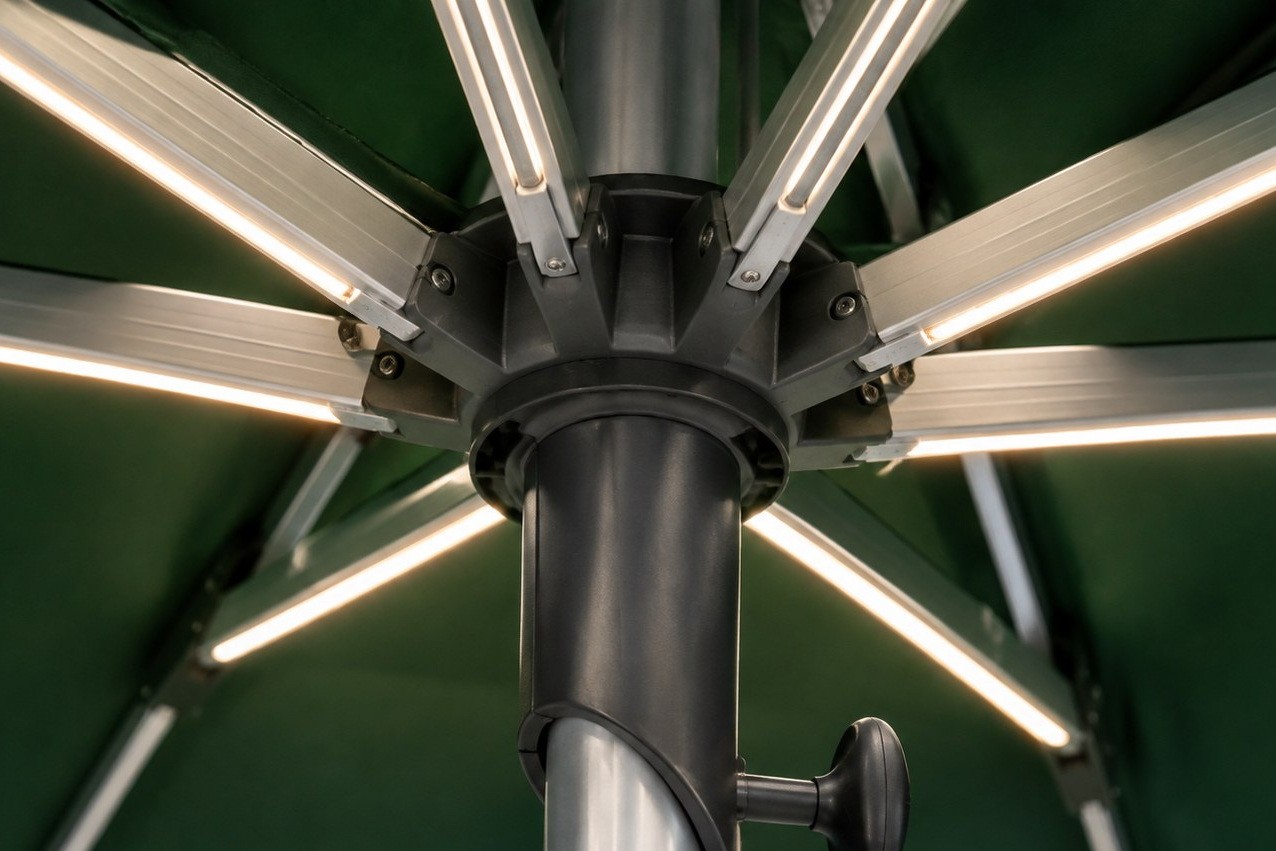
The part buyers usually call "the top" is the hub, the fitting where the ribs meet the pole. It is a small, cast or machined part, and it is the fitting whose shape changes most often between production batches, which is why a photograph is so useful when ordering one.
The opening mechanism, and why the name matters
Three systems are used on this range, and the term for each is worth getting right because it determines what wears.
Push-pull. The canopy is pushed up the pole rather than wound. Fewest wear parts.
Crank. A winding handle drives the canopy through a mechanism. Common on large side-pole and cantilever models.
Rope-and-pulley. The traditional lift, with a rope running over a pulley and held at a cleat. Most wear points.
The parts that belong to this group are the assembly itself, the handle or slide, and on rope systems the rope, pulley and cleat. When a venue says "the handle is broken", the useful question is which of the three systems the handle belongs to.
The structural parts
The pole, or on a cantilever the main pole and the inclined pole that carries the canopy out to the side. Pole sections are specified as, for example, Ø48 x 1.2mm on a compact model, 86 x 86 x 2.4mm on a heavy commercial square section, and up to 100 x 2.7mm on the oversized frames. The finial is the cap at the very top of the pole, and it is a small part that is easy to lose during a canopy change.
The rotation parts
On models that turn, the rotation assembly is the mechanism that lets the canopy swing. On this range several models offer full 360-degree rotation, and the bearing and locking parts within it are their own group of spares.
The base and fixing parts
The base itself, the base plates on a modular base, the centre pole socket that receives the pole, and the fixing kit that ties the base down. Base parts are covered in their own section below, because the sizes and fits are specific and a wrong plate is a wasted order.
Which parts fail first, and which quietly outlast the umbrella
Ranked by how often a commercial venue orders them, the order is stable across sites.
First: the canopy. Not because it is badly made, but because it is the only part doing outdoor work in full exposure every day. Fading, abrasion at the rib ends, stitching that goes at the stress points, and mildew that follows a season of being closed wet. A canopy on a busy terrace is the part that visibly ages.
Second: the operating mechanism. A crank handle that has been wound twice a day for three years, a rope that has run over a pulley through a few thousand cycles, a push-pull slide that has been worked in salt air. These are genuine wear items, and they are the reason the choice of opening system matters so much.
Third: the ribs and hub. Usually not worn out but damaged: a rib bent by a gust that caught an open canopy, a hub stressed by someone forcing a mechanism that had jammed. Replacement is normally event-driven rather than age-driven.
Fourth: base plates and fixings. A cracked plate after impact, a lost fixing kit after a refit, a socket that no longer holds the pole firmly.
Rarely: the pole and the structural frame. On an aluminium frame the pole is not the part that expires. When a pole is replaced it is almost always because of impact or because a venue is changing the size, not because it wore out. This is the single most useful thing to understand about umbrella economics: the expensive part is the part you rarely replace.
The mechanism you specify decides your five-year parts bill
This is the part of the buying decision that most quotations do not spell out, and it is the part that determines what you will be ordering in year three.
Rope-and-pulley lift. The traditional system. It works, and it is well understood, but it has the largest number of wear points of any option: the rope, the pulley, the cleat that holds the rope, and the guide the rope runs through. Rope and pulley parts appear on only a couple of models in this range for a reason. Every one of those points is something that can need attention.
Crank lift. A hand crank drives the canopy open through a winding mechanism. Fewer exposed points than a rope system, and it gives the mechanical advantage to open a large canopy with one hand. It is the common choice on large side-pole and cantilever models, and it still involves a mechanism that takes daily load.
Push-pull. The operator pushes the canopy open along the pole rather than winding it. This is the design with the fewest wear parts, and the product pages say so directly: on the FHUM104 the opening is described as replacing fragile rope-and-pulley systems, with far fewer wear parts and lower long-term maintenance. The FHUM006 makes the same argument from the other direction, describing a push-pull mechanism with fewer mechanical wear parts and weather-resistant finishes that together reduce replacement cycles.
The implication for spare parts is direct. The choice does not change what is available in year five; it changes how much of it you need. A venue that specifies push-pull is not buying a better warranty. It is buying fewer future orders.
There is a second mechanism argument worth knowing. On the FHUM109, a gas strut absorbs shock as the canopy moves, which extends the mechanism's service life rather than passing the load into the frame. And on the FHUM098, the specification states the benefit plainly: smoother operation with less force, longer service life in commercial use, and reliable operation across 3x3m, 4x4m and 5x5m sizes. When you compare two quotations and one of them mentions fewer moving parts, that sentence is a parts-cost forecast, not marketing.
The parts that only exist on a cantilever
A cantilever umbrella carries its canopy out to the side of the pole, which means it has parts a centre pole model does not have at all. If your site runs cantilevers, these are the components to understand before you need them.
The inclined pole, or arm. The section that carries the canopy out and away from the main pole. It takes the bending load that a centre pole umbrella never sees, which is why cantilever frames are specified in heavier sections than centre pole frames of the same canopy size: on this range a cantilever main pole runs up to 65 x 105 x 2.0mm, against Ø48 x 1.2mm on a compact centre pole model.
The strut. On models with a gas-assisted opening, the strut carries and absorbs the load of the moving canopy. The FHUM109 specification describes it exactly this way: the strut absorbs shock to extend the mechanism's service life. A strut is a wear part with its own service interval, and it is one of the few parts on an umbrella that behaves like a component on a machine rather than a piece of furniture.
The rotation and locking assembly. Many cantilevers on this range rotate through a full 360 degrees, with models also offering tilt and swivel. The rotation and locking parts take the load whenever a member of staff swings the canopy, and on a busy terrace that is several times a day.
The detachable frame sections. On a model such as the three-part cantilever with detachable aluminium structure, the frame separates into sections by design. This is a logistical advantage rather than a spare part as such, but it changes how a repair is done: a section can be replaced rather than an entire frame, which is exactly the property that makes a long parts programme useful.
Base and fixing parts, and why the fit matters more than the finish
Bases are sold separately on most of this range, in water tank, resin and iron plate options, and they are listed under umbrella bases and accessories rather than under the umbrella models. That is deliberate: the right base depends on the surface, the exposure and the canopy size, and a base specified with the umbrella would be a base specified without knowing the site. It also means a base can be upgraded later without changing the umbrella, which is one of the more common reasons a venue orders a base as a spare part rather than a repair.
The consequence for spare parts is that base parts are ordered against a fit, not against a model. Two numbers govern almost every base query.
The pole fit. The socket has to accept your pole diameter. As an example, the FHST064 steel-plated concrete base takes a Ø48mm or Ø58mm centre pole, and it is specified as a round weighted base with a centre pole socket.
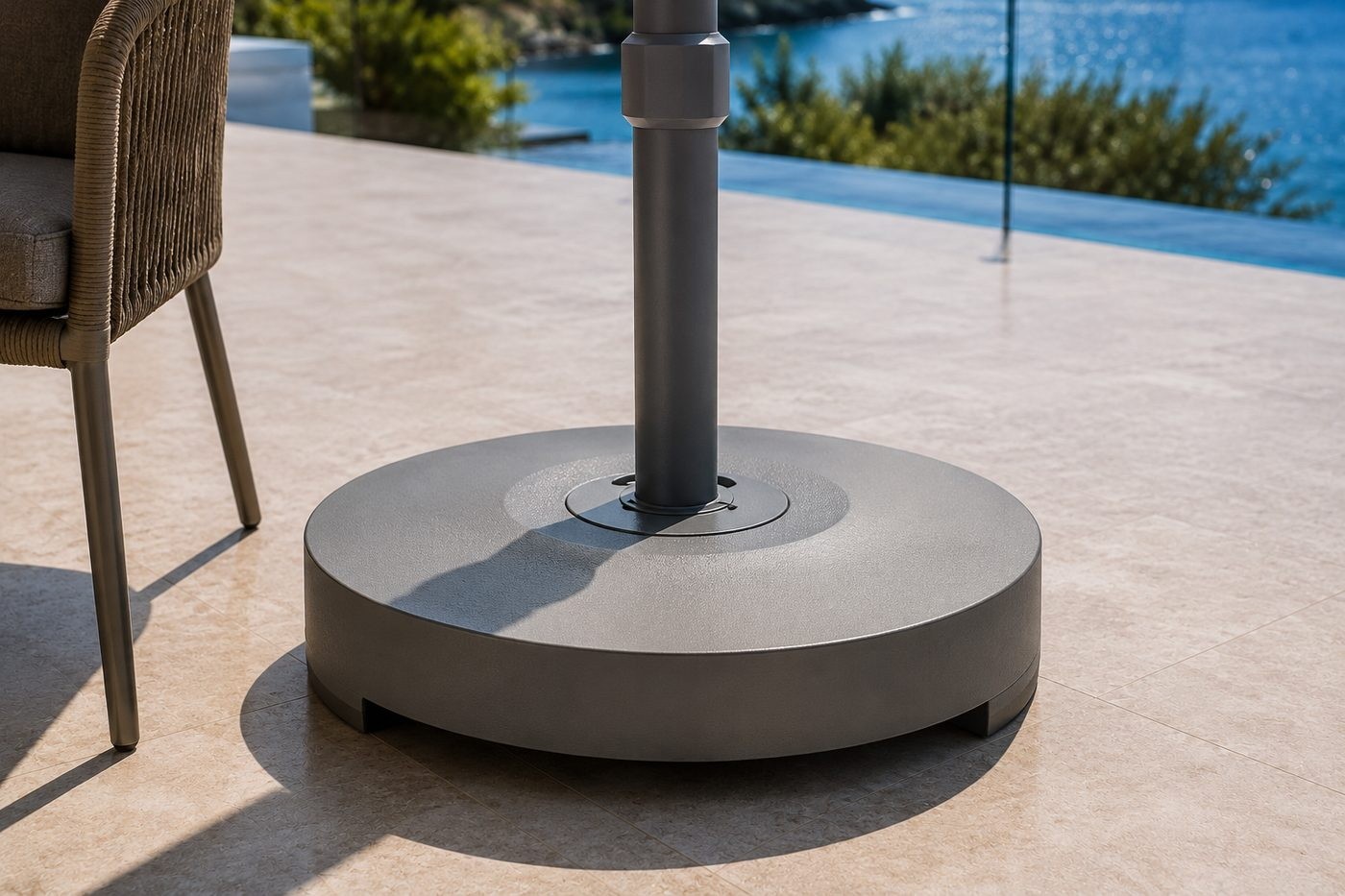
The weight, and how it is delivered. A base is a logistics problem as much as a stability problem, and on upper floors or through service corridors the delivery route decides which base is viable. Traditional 160kg cantilever bases are a single block that is effectively impossible to move to an upper terrace. The split designs solve exactly that: on the FHST063, the ballast breaks into four or eight plates of 45 x 45cm, each weighing a manageable 18 to 24kg so two installers can carry the kit through hotel corridors and up to a rooftop, with an HD polypropylene connector tying the plates together. The modular marble equivalent works the same way, with 46 x 46 x 5cm slabs at around 28kg each.
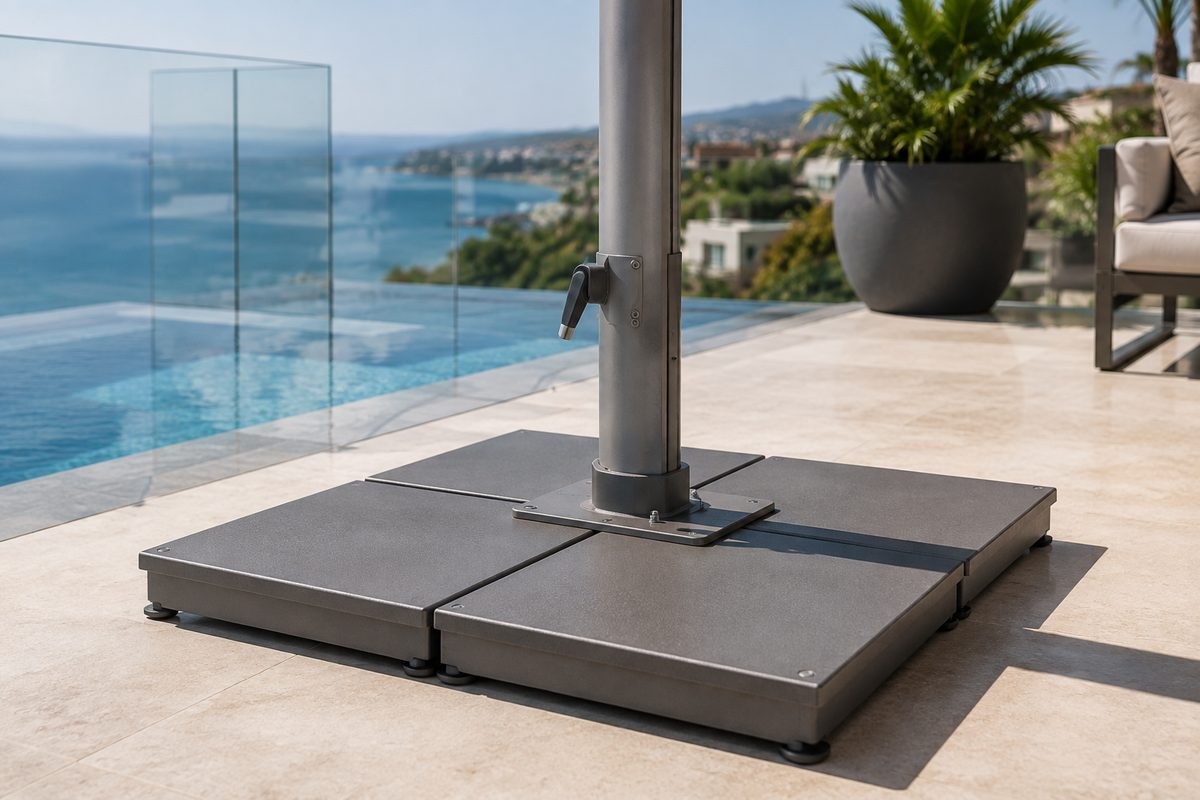
The fixing kit. The part that ties the base to the paving or the deck. Easy to lose during a refit, and a genuine spare part rather than an accessory.
For water-fillable bases the practical spares are different again: the fill cap, the drain plug and the handle on models that have one. These are low-cost parts and worth holding, because a base that cannot be emptied is more likely to be damaged by frost than by wind.
What five years of parts actually covers
The commitment is specific, and it is worth reading as written rather than as assumed.
What is included. Replacement canopies made to your original size, fabric and colour. Ribs. Hubs. Cranks. Finials. Base plates. Fixing kits.
How long. Five years after purchase, for the standard ranges.
How fast. Common parts are held in stock, and most orders ship within seven days. That figure is the one that matters operationally: a terrace with twenty umbrellas and four failures cannot wait a month for a hub.
How it is priced. We quote the same day. Send the model, the part and the quantity.
What makes it work. Timing. A five-year parts programme is only useful if the parts are identified before they are needed. A venue that knows its model codes can order a hub on a Tuesday and be back in service the following week.
The commitment is set out in full on the spare parts and replacement canopies question, and the wording there is the version that governs an order.
What the five-year commitment does not mean
Four things are worth stating plainly, because they are the assumptions buyers make and then discover are wrong.
It is not a five-year warranty. Parts availability and warranty are separate promises, and they run on different clocks. This is covered in its own section below.
It does not cover damage. Impact, storm damage, a canopy left open in a gale, or a mechanism forced past its limit are not wear. Those are repairs, and they are quoted as repairs.
It does not cover every model equally. The commitment is written for the standard ranges. Custom sizes, custom fabrics and project-specific structures are quoted case by case, which is why the model code matters so much on a customised order.
It does not remove the need to maintain anything. A part that is available in year five is not the same as a part that lasts five years. The maintenance articles on this site cover the fabric and frame routines separately, and they are the reason a canopy reaches year five at all.
How to identify the part you actually need
Most spare-parts orders go wrong at identification, not at supply. Three pieces of information solve nearly every case.
The model code. This is the single most valuable piece of information a venue can keep. It is on the order confirmation, on the quotation, and on the product page. A model code lets us look up the exact rib section, hub version and canopy pattern rather than guessing from a photograph.
A photograph of the damaged part. A photo resolves the version question that a model code alone sometimes cannot. Umbrella ranges evolve: a hub that was cast in one shape two years ago may be machined in another today, and both may be correct for the same model. A photo of the failed part lets us confirm which version is on your site.
The quantity, and how the umbrellas are used. A venue that replaces two canopies a season is buying differently from one replacing twenty in a single phase. Quantity also affects how a part is packed and shipped.
If a venue has lost its model codes, the route is still open: send a photograph of the umbrella, and we will identify the model and the parts from it.
Matching a replacement canopy to umbrellas you already own
This is the problem that catches hotels and restaurant chains, and it is worth planning for rather than discovering.
A canopy replaced in isolation will not match a site where the rest of the umbrellas are three years old. Even with the same specification, three years of UV moves a fabric. If you replace one canopy on a row of twenty and the new one is visibly darker, the mismatch reads as a mistake.
Two things prevent it.
Order the canopy to the original specification. A replacement canopy is made to your original size, fabric and colour, not to a generic equivalent. That is what keeps a phased replacement coherent.
Replace in phases that make visual sense. Chains that maintain a consistent look replace in matched groups rather than one unit at a time, and they order canopies against the site's model code rather than from memory. Where a full row is due, replacing the row is usually a better decision than replacing the worst three.
The part of this that is easy to overlook: fabric and colour matching is only possible while the original fabric is still in the programme. Keeping the model code and the original fabric reference on file is what makes year-five matching straightforward rather than approximate.
How to order a spare part, step by step
Step one: identify the model and the part. Model code plus part name plus quantity. A photograph of the damaged part if the version is uncertain.
Step two: get the quotation. Same day. The quotation covers the part and its packing.
Step three: confirm and dispatch. Common parts ship from stock, most within seven days. Parts that are made to order, principally replacement canopies, are produced to your original specification.
Step four: fit. Most mechanical parts are designed to be replaced with ordinary hand tools rather than returned to a workshop, which is what makes an on-site repair practical for a venue with an engineering team.
Step five: if the part is needed urgently, say so. A venue with a terrace full of guests has a different urgency from one planning winter maintenance, and the two orders should be handled differently.
The replenishment route, for operators who order in volume
There is a second way to get parts, and it is used by venues that work through the season rather than stopping for repairs.
Under the replenishment process documented on the product pages, once the quantity and details are confirmed we ship the replacement with your next order, or ship it to you separately if it cannot wait. Thirty of the seventy-nine products on this site carry that line, across centre pole umbrellas, LED models, side upright and cantilever umbrellas, large commercial umbrellas and bases.
For a venue ordering seasonally, this is usually the most economical route: the parts ride with an order that was going out anyway, and the terrace keeps running while the replacement is in transit. For a single failed umbrella in mid-season, the separate shipment is the practical choice.
Warranty and spare parts are two different promises
These are commonly confused, and the confusion leads to unrealistic expectations in both directions.
The warranty covers defects in materials and workmanship for twelve months from the date of loading. It is a quality guarantee on what we supplied.
The parts programme covers availability for five years. It is a commitment that the part will still exist, and that we will still sell it to you.
A canopy that fades after two seasons is neither: it is normal weathering on a wear item, and the right answer is a replacement canopy rather than a warranty claim. A hub that fails in month four because of a manufacturing fault is a warranty matter. A crank that wears after three years of daily use is a spare part. Knowing which of the three you are dealing with is what makes a claim straightforward instead of adversarial, and it is the first question a supplier should ask you.
What a commercial venue should hold as spares
The right spares kit depends on the size of the installation, but the logic is consistent: stock what fails fast and costs little, order what fails slowly and costs more.
For a terrace of ten to thirty umbrellas, the useful stock is small and mechanical: a couple of crank assemblies or push-pull slides, one or two hubs, a set of ribs, and a fixing kit. These are the parts that take a terrace out of service, and holding one of each converts a two-week outage into an afternoon's work.
For larger sites, the sensible approach is to standardise. A site built on one model family shares parts across the range, which is exactly what the FHUM069 programme is designed around: one model family solving multiple layout needs with shared spare parts, with after-sales spares supported from layout advice through to rollout. Fewer distinct parts across a site means fewer lines to keep and less to get wrong.
Canopies are different. They are the most expensive single part and the one most affected by storage, so most venues order them against known condition rather than holding them. A canopy kept in a damp store for two years before fitting is not a saving.
The specification lines that make year-five ordering possible
A parts order in year five is only as good as the records kept in year one. Four lines per model are enough, and every one of them is on the product page and the quotation.
Pole section. The measurement that identifies the frame.
Rib section and rib count. The measurement that identifies the arms.
Fabric weight and coating. The measurement that identifies the canopy.
Opening mechanism. The system that tells you which parts wear.
Here is how those four lines look across the centre pole range and the larger side pole and cantilever frames, from a compact model to the largest commercial sections.
| Model | Type | Pole | Ribs | Fabric | Opening |
|---|---|---|---|---|---|
| FHUM104 | Centre pole, double-tier | Ø48 x 1.2mm | 14.5 x 24 x 1.0mm | 250g polyester, PA coating | Push-pull |
| FHUM069 | Centre pole | Ø48 x 1.8mm | 20 x 30 x 1.2mm | 280g polyester, PA coating | Push-pull |
| FHUM006 | Centre pole, three-tier ventilated | Wood-grain aluminium | 14.5 x 24 x 1.0mm | 250g polyester, PA coating | Push-pull |
| FHUM053 | Side pole | 77 x 53mm | 14 x 24mm, 8 ribs | 260g yarn-dyed, PU coating | Crank |
| FHUM099 | Cantilever, solar LED | 65 x 105 x 2.0mm | 20 x 30 x 1.2mm | 260g polyester, PU coating | Cantilever |
| FHUM098 | Centre pole, oversized | 100 x 2.7mm | 35 x 22mm, 12 ribs | 300g yarn-dyed, PA coating | Not listed |
| FHUM098 | Centre pole, poolside | 86 x 86 x 2.4mm | 25 x 33 x 1.5mm, 8 ribs | 250g yarn-dyed, PA coating | Hand-winding |
Base parts are identified the same way, and the two numbers that matter are the pole fit and the plate size.
| Base | Weight | Plate size | Pole fit |
|---|---|---|---|
| FHST064 | 45kg | Ø55 x 45cm | Ø48mm or Ø58mm |
| FHST063 | 160kg, split | 45 x 45cm per plate, 4 or 8 plates | Cantilever |
Two observations follow from these tables, and both are useful when planning a site.
The first is that the same model name can appear at more than one specification. The FHUM098 shows 12 ribs on one listing and 8 on another, with different pole and rib sections and different fabric weights, and only the poolside build documents its opening as a tool-free hand-winding mechanism. This is normal for a large model offered in more than one build, and it is precisely why a spare-parts order should carry the model code and the specification rather than the model name alone. Where a build does not document a given line, treat it as something to confirm with us rather than something to infer: the pole and rib sections in the table are the values to quote when you ask.
The second is that the spread of rib sections across this range is wide, from 14 x 24mm to 35 x 22mm. A rib is not interchangeable between models, and a venue that standardises on one model family across a site makes parts simpler for exactly this reason.
After a storm: damage is not wear
The distinction between a worn part and a damaged part decides who pays, and it is worth having a protocol rather than an argument.
Inspect the mechanism before the fabric. A canopy that has been stressed will usually show the damage first, but the cause is often in the mechanism: a canopy opened against a jam, or a slide forced past its limit. Replacing a canopy without checking the mechanism is how the same failure repeats twice.
Check the hub and the ribs as a set. A bent rib usually means a stressed hub. These two are commonly replaced together because a hub that has taken a shock is not obviously damaged until it fails under load.
Check the base and the fixings. Storm loads arrive at the point where the umbrella meets the ground. A base that has shifted, or a fixing kit that has pulled, is a stability issue rather than a cosmetic one.
Record what happened. A photograph and the model code at the time of damage is what turns a repair quotation into a same-day answer, and it is the record that tells you which parts your site actually consumes.
The rule of thumb for commercial sites: close and secure canopies whenever winds pick up, and do not leave a canopy open in storms or freezing conditions. That single routine is the most effective parts-cost reduction available, and it costs nothing.
What to check before you accept a quotation
Five questions separate a quotation that will still work in year five from one that will not.
Does it state the model code? Without a code, spare-parts identification in year three becomes guesswork.
Does it name the opening mechanism? Push-pull, crank or rope-and-pulley. The answer is the best available forecast of your future parts orders.
Does it state the rib section and pole section? These numbers are how a part is matched years later. On this range they run from 14.5 x 24 x 1.0mm ribs on a compact centre pole model up to 35 x 22mm ribs and a 100 x 2.7mm pole on the large commercial frames, so a quotation that omits them is a quotation you cannot re-order from.
Does it state the fabric weight and coating? A canopy is matched on weight and coating as much as on colour, and the range here runs from 250g polyester with PA coating up to 300g yarn-dyed fabric.
Is the base quoted separately? Bases are sold separately on most models, with water tank, resin and iron plate options. That is not an omission, but a quotation that does not say so invites a surprise on the loading plan.
The parts that are specific to LED models
LED umbrellas add a second system to maintain, and it is worth understanding which parts of it are field-replaceable and which are not.
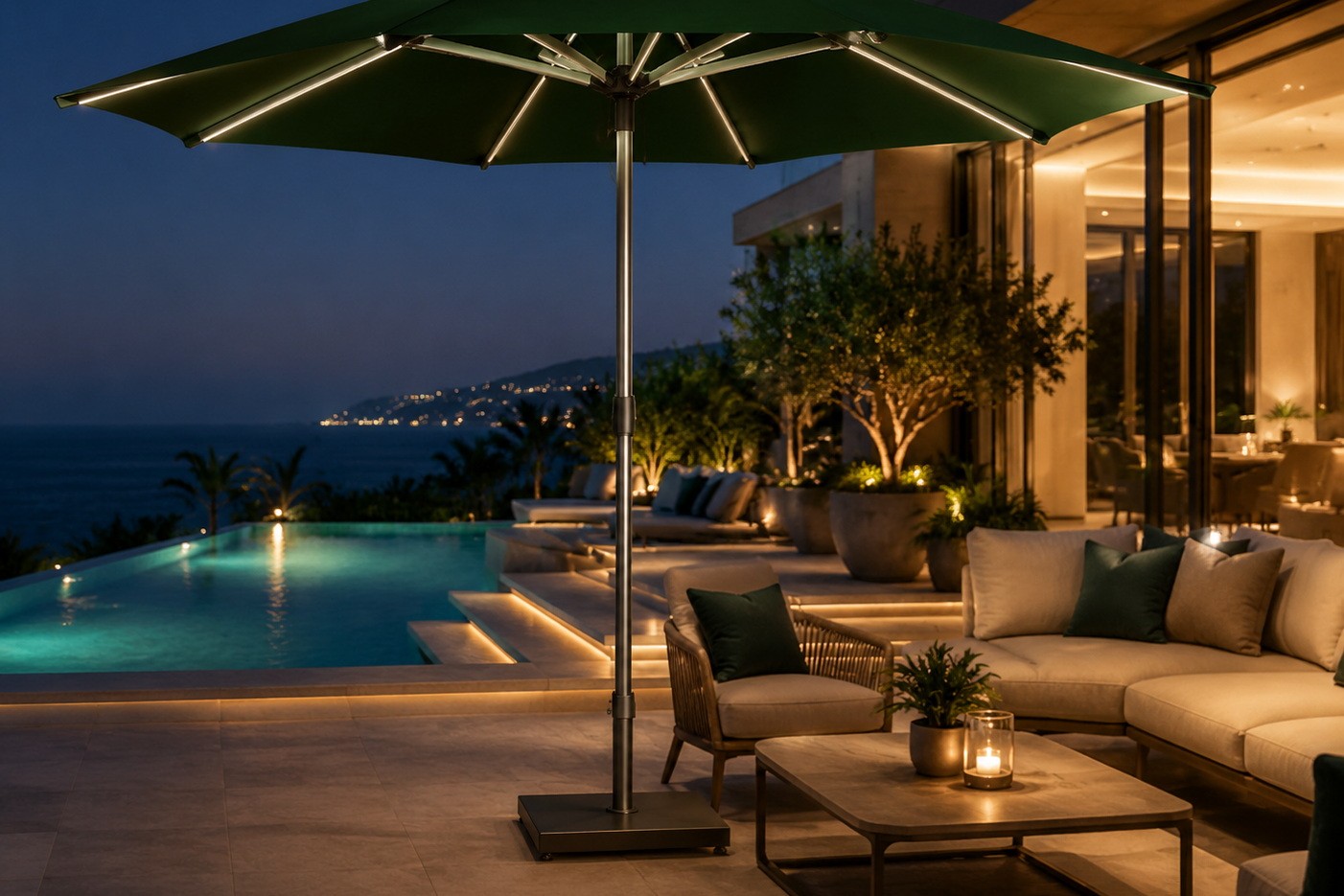
On this range the lighting is built into the ribs rather than hung from the frame, with the LED strips running along the ribs and casting light down across tables and seating. That construction has a practical consequence for spare parts: an integrated strip is part of the frame assembly rather than a separate accessory, so a light failure is diagnosed against the model's electrical specification rather than by swapping a lamp.
The parts that matter on an LED model are the strip or rib assembly, the driver, the switch and, on models with a battery, the battery housing. If you operate LED umbrellas, the specification detail worth keeping on file is the control arrangement and the IP rating, because both travel with the frame and both are needed to order correctly years later.
Why the parts bill is a design outcome, not a maintenance outcome
There is a comfortable assumption that a well-maintained terrace has a low parts bill and a neglected one has a high one. Maintenance matters, and the care articles on this site cover it properly. But on commercial umbrellas the larger variable is the specification, and the products themselves say so.
The framing used across this range is replacement cycles, not repair costs. The FHUM006 page puts it as a design property: fewer mechanical wear parts and weather-resistant finishes together reduce replacement cycles, and it states the benefit as lower lifetime cost. The FHUM069 page makes the same claim in the opposite direction, describing a fabric that resists fading under constant UV exposure and sheds light rain, and concluding that this reduces replacement cycles. On the FHUM104 the argument is mechanical: compared with rope-and-pulley systems, the push-pull opening has far fewer wear parts, which lowers long-term maintenance for commercial operators. And the FHUM099 frames the outcome in time, noting that operators see fewer replacements over a typical three to five year service life.
Three design decisions sit behind those sentences, and all three are visible in a specification before you buy.
The opening system. Fewer wear parts means fewer of the parts that generate repeat orders. This is the single largest lever.
The fabric specification. Weight and coating determine how a canopy responds to UV and rain, and therefore how often it is replaced. On this range that runs from 250g polyester with PA coating to 300g yarn-dyed fabric.
The section sizes. A pole at 86 x 86 x 2.4mm and a rib at 25 x 33 x 1.5mm resist loads that a lighter frame passes into its joints. Heavier sections move failures away from the parts that are awkward to replace.
None of this argues against buying the lighter model. A compact terrace with modest exposure is better served by a compact umbrella, and the correct answer is the one that matches the site. What it does argue is that the parts programme should be read as a backstop rather than a plan. Five years of availability exists so that a venue is never stuck, not so that a venue can specify loosely and repair indefinitely.
How the leading brands handle parts
Four names come up most often when buyers compare commercial shade: TUUCI, Glatz, Treasure Garden and Bambrella. What each of them gets right on engineering, product breadth and material identity is covered in a separate article on the leading outdoor umbrella brands. Here the question is narrower and more practical: what does each of them actually do about the part that breaks?
TUUCI: modular by design, parts through the dealer
TUUCI sits at the top of the market, and its approach to parts follows from how it builds. Dealer material describes TUUCI shade products as engineered modularly for easily replaceable parts and accessories, including stainless steel fasteners, and the frames are built from marine-grade weather-resistant materials including fibreglass, armor-wall aluminium and Dura-TEAK composites. Replacement components exist as numbered parts, and the canvas is available as a separate item.
The trade-off is the route. Parts, warranty and service run through the dealer network rather than direct: TUUCI's own operating instructions direct all customer service, warranty and parts inquiries to the dealer the umbrella was bought from. If your site buys through a distributor, that is workable. If you operate across several countries, or need a part identified and matched in a hurry, it means going back through the channel each time.
Glatz: a formal spare-parts programme, dealer only
Glatz is a Swiss family business and a leading European sunshade manufacturer, and it runs spare parts as a formal, catalogued part of the offer. Its spare parts and accessories section is organised into fixation, base, protective covers, fabric canopies and lighting. The company's own wording is direct about intent: original spare parts exist to ensure that a parasol continues to provide reliable shade for many years on.
Two details in that programme matter to a buyer. The first is the channel: Glatz states that these parts are available exclusively from its sales partners, so availability at any given moment depends on the dealer rather than only on the factory. The second is the boundary that comes with it: Glatz advises that only original Glatz accessories be used, and states that the guarantee is not valid otherwise. A well-documented programme with a firm edge around it.
Treasure Garden: parts sold as products
Treasure Garden's strength is product breadth, and its parts follow the same logic. Replacement canopies and replacement frames are sold as separate products, so a frame can be re-canopied and a canopy can be re-framed without replacing the pair. For venues that wear one component faster than the other, that structure is genuinely useful.
Two lines are worth reading carefully on a Treasure Garden quotation. The first is the warranty scope: documentation on some models warrants the product for residential use, which is a different promise from a commercial one. The second is the service route: warranty service is handled by contacting the original authorised dealer.
Bambrella: guarantee, wind testing and print
Bambrella has built its identity on bamboo, aluminium and stainless steel, and it publishes two figures that buyers respond to: wind tunnel testing to 126 km/h, and a guarantee of one to five years across its commercial and residential parasols. On branding it goes further than most, offering printed and promotional parasols with Pantone, screen and digital printing and no minimum order quantity on that programme.
For a venue specifying printed shade, that last point is worth knowing, because a branded order can be placed at a unit quantity most factories would decline. The trade-off is that the parts side is not published as a catalogue in the way Glatz's is, so replacement availability is something to confirm model by model rather than to assume.
Where Foris Hortus fits, and how we handle parts
Between the architectural top of the market and the entry level there is a large middle ground: engineered, customisable, commercially practical shade bought by hotels, restaurant groups, resorts and distributors who need repeatable product rather than a one-off landmark. That is the space Foris Hortus occupies, and it is where the parts question stops being a service issue and becomes a purchasing decision.
Our position on parts is deliberately simple, and it is stated the same way everywhere on this site.
Availability. Five years after purchase for the standard ranges, covering replacement canopies, ribs, hubs, cranks, finials, base plates and fixing kits.
Speed. Common parts are held in stock, and most spare-parts orders ship within seven days.
Matching. A replacement canopy is made to your original size, fabric and colour, so a phased replacement does not leave one umbrella visibly newer than the rest of the row.
Route. Direct, with no dealer layer between the venue and the part. Send the model code or a photograph and we quote the same day.
Customisation. Where a project needs it, the range supports Pantone colour matching, logo printing on canopy corners and valance, custom sizes, and structural change including integrated LED, all of which are set out under logo and branding and LED and lighting solutions. Light customisation starts at 100 pieces and structural change at 300, which is a higher entry than a print-only programme. What that buys is a specification that can be re-ordered in year three, and a parts list that covers the whole family rather than the single model that happens to be on site.
Warranty. Twelve months from the date of loading, running alongside five-year parts availability. These are different promises on different clocks, which is why they have their own section above.
The honest summary is that the four names above are not weak on parts. Glatz catalogues its spares, TUUCI modularises for replacement, Treasure Garden sells frames and canopies separately, and Bambrella backs its range with a long guarantee. What differs is the route and the terms. If your estate is in Europe and buys through a Glatz dealer, that programme is excellent. If you buy directly, run several sites, or need a part identified from a photograph and quoted the same day, our model is built for exactly that.
Sources for the brand comparison
The statements about other manufacturers above are theirs, not our assessment of them, and each is taken from published material.
- TUUCI: frame materials and the direction of parts, warranty and service inquiries to the dealer appear in TUUCI operating instructions published with its umbrella models; the description of the range as engineered modularly for easily replaceable parts and accessories, including stainless steel fasteners, appears in dealer product material.
- Glatz: the spare parts and accessories programme, the categories within it, availability exclusively from sales partners, and the statement that the guarantee is not valid where non-original accessories are used, are all published on the Glatz spare parts and accessories pages.
- Treasure Garden: replacement frames and replacement canopies sold as separate products, the residential-use scope on some models, and warranty service through the original authorised dealer, appear in retailer listings and in Treasure Garden product documentation.
- Bambrella: the wind tunnel figure of 126 km/h, the one to five year guarantee across commercial and residential parasols, the material set of bamboo, aluminium and stainless steel, and the no-minimum-order print programme, are published on Bambrella's own site.
Where a brand's practice changes, the brand's current published terms govern. Our own terms are the ones set out in the sections above, and they are the ones we will be held to.
Common questions
Can I buy a replacement canopy without buying the frame? Yes. Replacement canopies are made to your original size, fabric and colour and are supplied on their own.
How long will a part be available? Five years after purchase for the standard ranges, with common parts held in stock.
How fast do spare parts ship? Most orders ship within seven days from stock. Made-to-order canopies take longer, because they are produced to your specification.
Can you match the fabric of my existing umbrellas? Send the model code or a photograph and we will match fabric and colour, so a replacement does not look different from the rest of the site.
What if I do not know the model? Send a photograph of the umbrella and we will identify the model and the parts you need.
Are spare parts covered by the warranty? Parts supplied under warranty are. Parts bought as routine replacements are not, but they carry the same five-year availability commitment.
Do you supply parts for bases? Yes. Base plates and fixing kits are part of the programme, and bases themselves are available separately across the water tank, resin and iron plate options.
Which parts should a venue keep on site? For most terraces, one or two operating mechanisms, a hub, a set of ribs and a fixing kit. These are the low-cost parts that stop a terrace working.
Start from the model code
The most useful thing a venue can do before it needs a spare part is to record what it owns. Model code, pole and rib sections, fabric weight and coating, and the opening mechanism. Four lines per model, kept with the site drawings.
With those four lines, a spare-parts order is a same-day quotation. Without them, every replacement starts with an identification exercise, and identification is where the time goes.
If you are specifying a new terrace and want to plan the parts side before you commit, tell us the space, the number of covers and the site's exposure, and we will recommend a configuration and the spares that should be held against it. If you already operate umbrellas and need a part, send the model code or a photograph, and we will identify it and quote the same day. Either way, send us the details and we will come back with the specification and the parts list together.