How Many Chairs Fit a Round, Rectangular or Extendable Outdoor Table? Seat-Count and Clearance Guide
- Share
- publisher
- Foris Hortus
- Issue Time
- Sep 24,2026
Summary
How many chairs actually fit a round, rectangular or extendable outdoor dining table? A practical guide to seat counts, edge per cover, floor clearance behind the chair, and how shade from a cantilever or centre-pole umbrella changes the seats you can really use - with published dimensions for every table in the range.
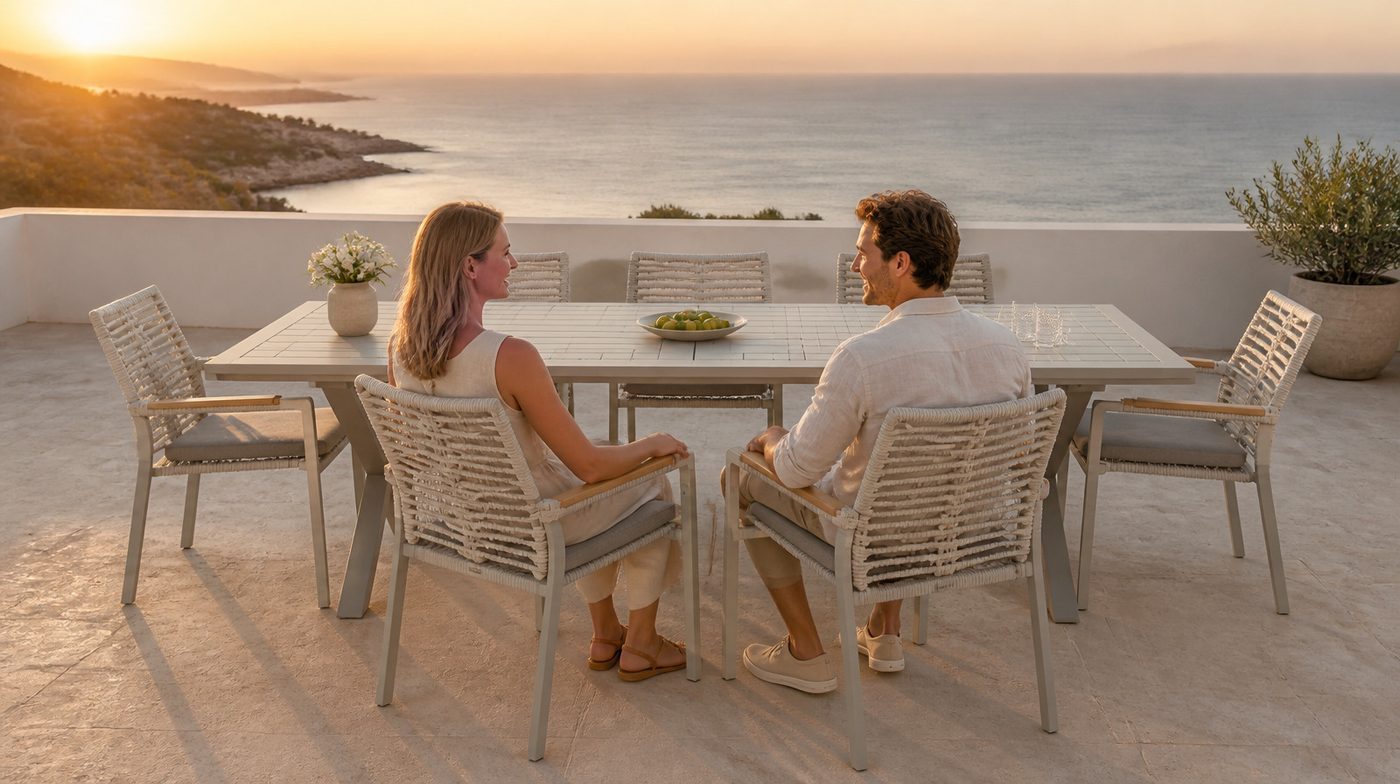
You found the table. It looks right, it fits the mood, and the render has six chairs around it. Then it arrives, you sit down, and you discover the truth: it seats four comfortably and six only if nobody at the table has elbows. This guide is about the number that decides all of it. Not the diameter, not the length — the amount of table edge each person actually gets, and the floor you need to leave behind the chair so someone can stand up without taking the tablecloth with them.
How many chairs fit an outdoor dining table? The short answer
Give each person about 60 cm (24 in) of table edge, and leave roughly 100 cm (39 in) of clear floor behind each chair. A round table seats fewer people than its circumference suggests because the arc is curved and the chairs are straight. A rectangular table seats more, because two long sides do the work. And an extendable table is the cheapest way to buy four extra covers — you already own the space, you just unfold it.
That is the whole guide in three sentences. The rest of this page is the arithmetic behind it, so you can check any table against your own terrace before you order — including the four dining tables in our range, whose published dimensions are used in every table below.
The number worth memorising: edge per cover
Hospitality planners work in "covers", and a cover is one person's place setting. The edge that setting occupies is the single most useful measurement in outdoor dining. Here is the band most furniture and tableware specifications land in, and it holds whether the table is on a villa terrace or in a hotel courtyard.
60 cm (24 in) per cover
The comfortable standard. Two plates, two glasses, a bread plate and a bit of air between neighbours. If a table gives you this much edge per person, nobody will complain about the seating.
50 cm (20 in) per cover
The practical minimum. Works for a quick lunch or a table of people who know each other well, and it is where catalogues start counting chairs that a real dinner will not use.
Chair width sets the floor
You cannot seat people closer than the chairs themselves. Dining chairs in our range publish widths from 56 cm to 59.5 cm, so below roughly 56 cm of edge per cover the chairs start touching before the guests do.
The chairs matter as much as the table here, and it is worth checking published widths rather than assuming. Our outdoor dining chair range lists each model's dimensions on the model guide, so you can compare a 56 cm chair against a 59.5 cm one before you decide how tightly you are willing to pack a row.
One more thing about elbows. A round table works differently from a rectangle here: on a round table, neighbours face slightly inward, so 60 cm of curved edge feels roomier than 60 cm of straight edge. That is why a 120 cm round table can feel generous with four people and cramped with six, even though the arithmetic says six fits.
Round, rectangular or extendable: seat counts side by side
Four tables from our range, measured three ways: the published size, the edge each cover gets at that headcount, and how the count reads in practice. The "edge per cover" column is simple arithmetic on the published dimensions — divide the usable edge by the number of covers.
| Table shape | Published size | Edge per cover at that count | Comfortable | Snug maximum |
|---|---|---|---|---|
| Round, fixed FHTB077 |
120 cm diameter, 75 cm high | 4 covers: about 94 cm each 6 covers: about 63 cm each |
4 | 6 (chairs nearly touch) |
| Round, extendable FHTB097 |
136.5 cm closed, 176 cm extended, 75 cm high | 4 covers closed: about 107 cm each 6 covers extended: about 92 cm each 8 covers extended: about 69 cm each |
4 closed, 6 extended | 8 extended with narrow chairs |
| Rectangular, fixed FHTB084 |
210 x 97 cm | 6 covers (3 a side): about 70 cm each 8 covers (4 a side): about 52.5 cm each |
6 | 8, plus room for one at each end |
| Rectangular, extendable FHTB068 |
220 cm closing to 280 cm extended, 122 cm wide, 74 cm high | 6 covers closed (3 a side): about 73 cm each 8 covers extended (4 a side): about 70 cm each 10 covers extended (5 a side): about 56 cm each |
6 closed, 8 extended | 10 extended |
Sizes in this table are the published dimensions for each model. The edge-per-cover figures are our arithmetic on those dimensions; the comfortable and snug columns are typical hospitality guidance, not manufacturer specifications, and your chairs decide the real limit.
How many chairs fit a round outdoor dining table?
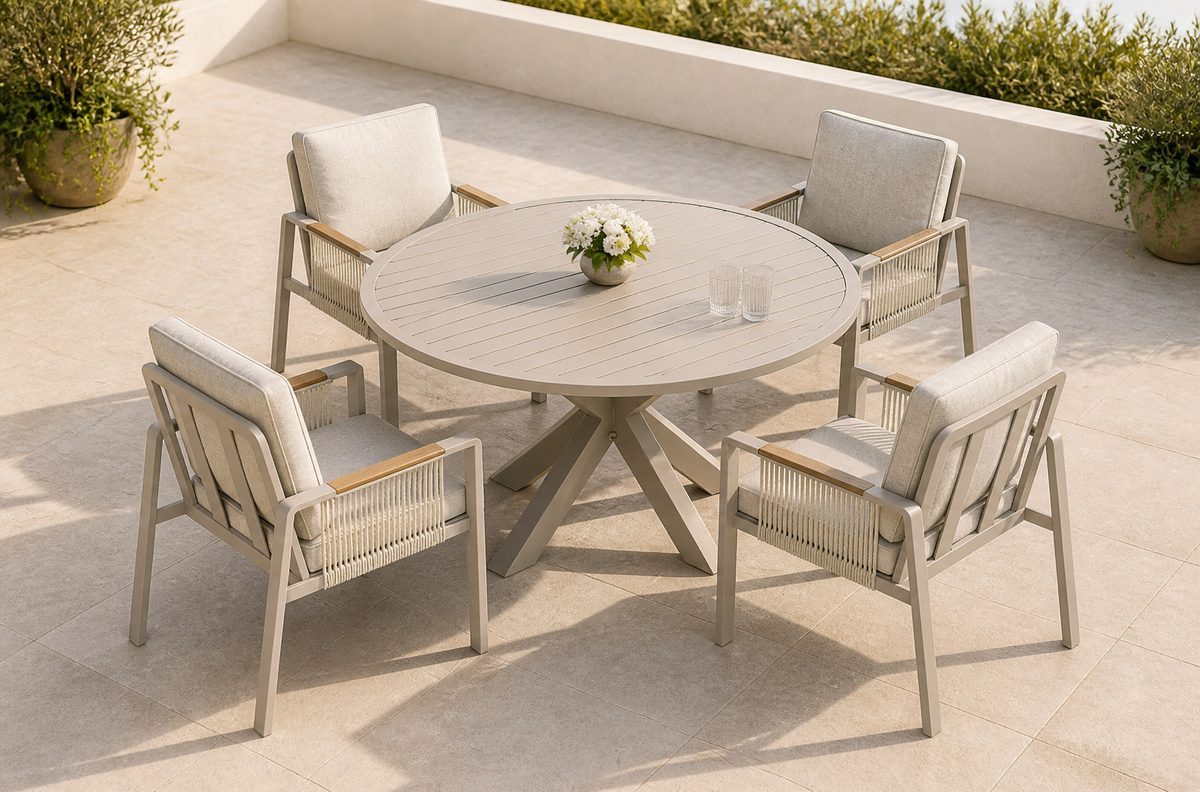
Round tables are the friendliest shape for small terraces and the easiest shape to get wrong, because the maths is not intuitive. The usable edge is the circumference, and circumference is 3.14 multiplied by the diameter — so a 120 cm round table has about 377 cm of edge, and a 176 cm one has about 553 cm. Divide by covers and you get the number that matters.
Here is how our 120 cm round table, the 120 cm round outdoor dining table with the sunburst slat top, works out. Four people get about 94 cm each — genuinely generous, the kind of table where the plates never meet. Six people get about 63 cm each, which is still above the 60 cm comfortable line on paper, but the chairs themselves are 56 to 59.5 cm wide and they are standing on a curve, so they end up almost touching at the back. Four comfortable, six only if the six are friends.
The extendable version changes that calculation in a useful way. Our round round extendable dining set with four or six rope weave chairs measures 136.5 cm closed and 176 cm open. Closed, four covers enjoy about 107 cm each, which is hotel-terrace territory. Opened, six covers get about 92 cm each — wider than most people expect from a table that only grew by 39.5 cm, because every extra centimetre of diameter adds 3.14 cm of edge.
If your terrace is tight and round is your shape, the honest recommendation is this: size for four and treat six as a bonus. A round table that seats four beautifully is more useful than one that allegedly seats six and never does.
How many chairs fit a rectangular outdoor dining table?
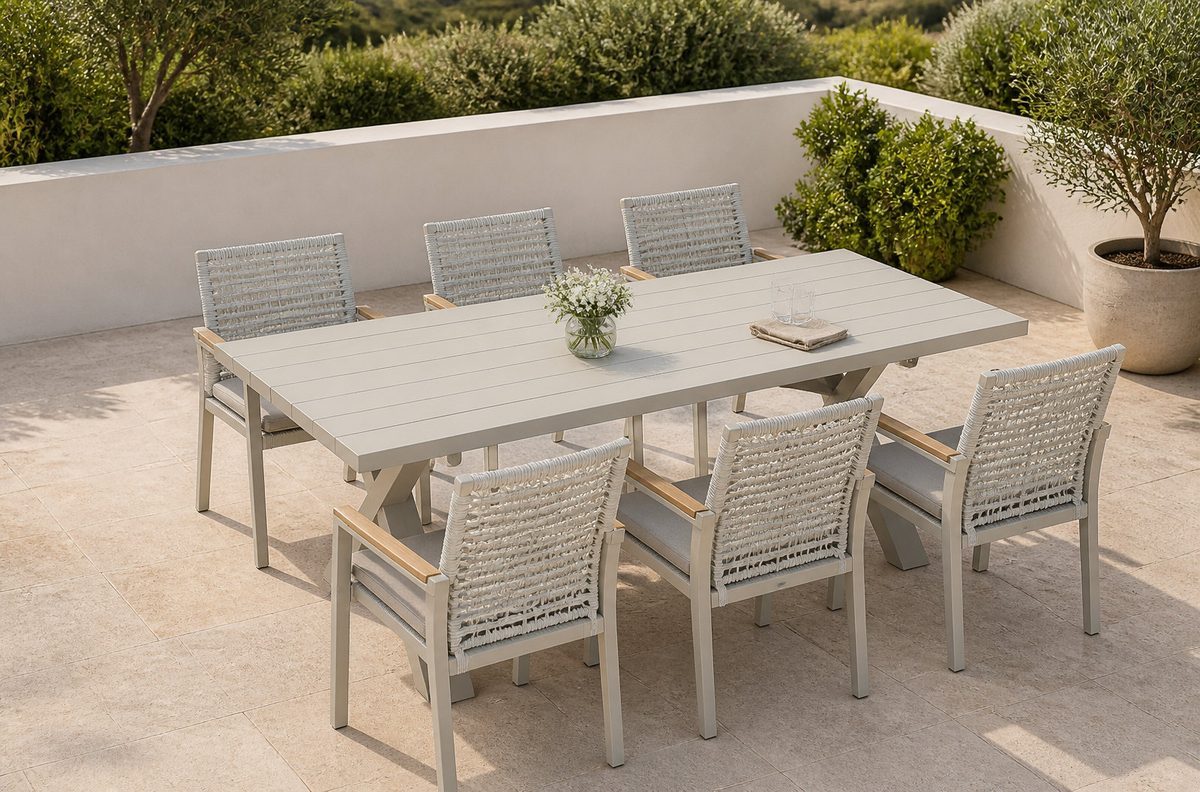
Rectangles are the efficient shape. Only the two long sides are really used, and because the edge is straight, chairs sit shoulder to shoulder without the curvature penalty a round table charges. Take our seven-piece dining set built around a 210 x 97 cm table. Each long side gives you 210 cm of edge, so three chairs a side is about 70 cm each, comfortably past the 60 cm line, and that is exactly how the set is published — one table, six rope weave chairs.
Push it to four a side and each cover drops to about 52.5 cm. That is inside the minimum band but outside the comfort band, and with 56 cm wide chairs it only works if nobody needs to reach for the salt without asking. The ends are the interesting part: at 97 cm wide, a rectangular table has room for one chair at each end, which is how the same table can hold eight people without anybody's shoulder in a neighbour's plate. Catalogues often forget the ends. Your guests will not.
The practical rule for rectangles: divide the long side by 60 cm, round down, then add two if the table is at least 90 cm wide. On a 210 cm table that gives you three a side plus two ends — eight covers from a table that looked like a six-seater.
How many chairs fit an extendable outdoor dining table?
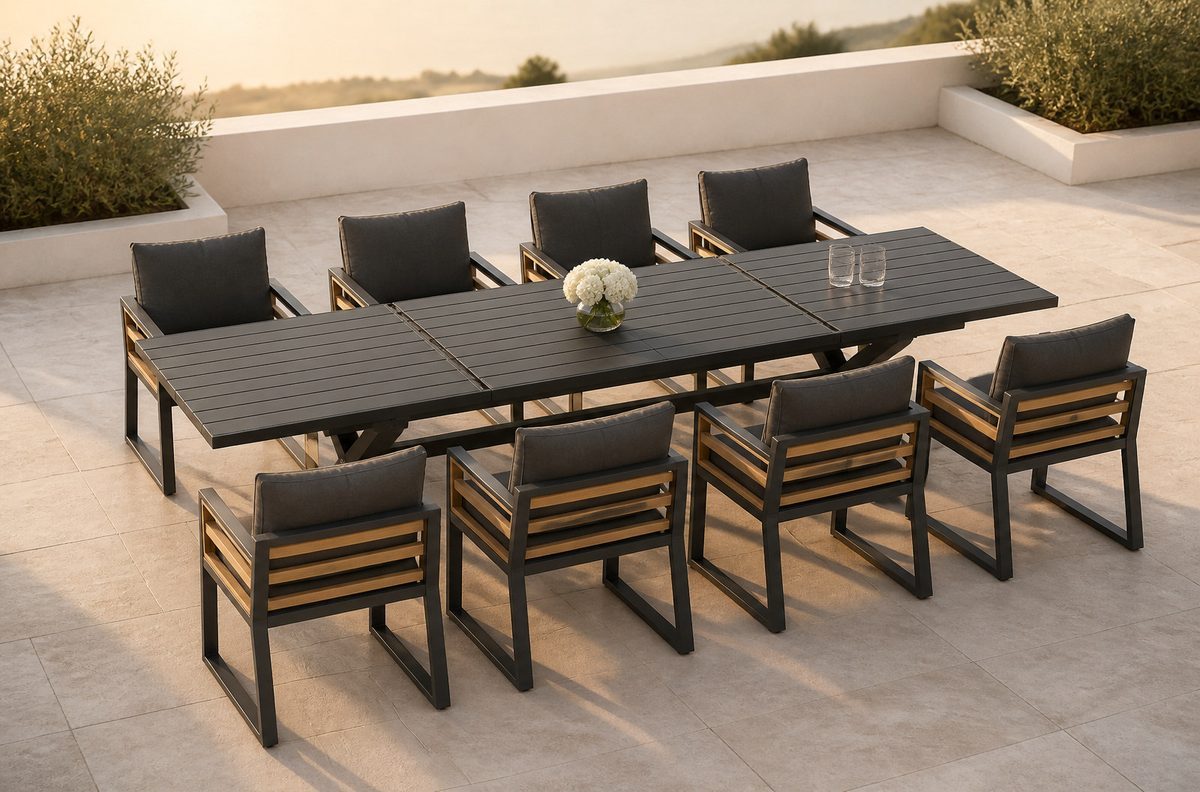
An extendable table is the only piece of outdoor furniture that changes its own seat count. Ours, the aluminium slat extendable table that goes from 220 cm to 280 cm, is 122 cm wide and 74 cm high, and the arithmetic moves like this. Closed, three chairs a side gives about 73 cm of edge per cover — a comfortable six. Open, four a side gives about 70 cm per cover, so an easy eight without losing any comfort at all. Push to five a side and you are at about 56 cm, which is the point where the chairs are touching and the table is technically a ten-seater.
That is the real argument for extending rather than buying bigger. A 280 cm table that lives permanently at 280 cm costs you floor space every day of the year, including the 360 days it seats four people. An extendable table gives you the extra four covers on the two days you need them, and gives you your terrace back on the rest.
One practical note from the warehouse: extension joints are the only moving part on a dining table, so they are the thing to check before a busy season. Wipe the mechanism, tighten the fixings, and work it open and closed once before the first big lunch rather than during it.
Clearance: how much floor an outdoor dining table really needs
Seats are half the story. The other half is the space behind them, and this is where most terrace plans fail — not because the table is too big, but because the chair has nowhere to go when someone stands up. A dining chair needs to travel backwards before it clears the table, and a person needs to walk behind a seated guest. Those are two different distances.
Two clarifications before the numbers, because "clearance" gets used for three different things. Here, clearance means floor clearance: the gap between the table edge and whatever is behind the chair. It is not the under-table legroom, and it is not the umbrella measurement of the same name — more on that below, because confusing the two is a genuinely common mistake.
| What you are measuring | Minimum | Comfortable | Why that number |
|---|---|---|---|
| Table edge to a wall or planter behind the chairs | 100 cm (39 in) | 110 to 120 cm (43 to 47 in) | One chair has to slide back and a person has to pass behind it. This is the measurement that decides whether a terrace feels generous or cramped. |
| Chair pull-back space to sit down | 75 cm (30 in) | 90 cm (35 in) | The chair back travels before you can step between it and the table. Less than this and guests sit down sideways. |
| Table edge to a wall with no chairs on that side | 60 cm (24 in) | 75 cm (30 in) | Enough for a person to walk past a seated guest without turning sideways. |
| Between two back-to-back tables | 110 cm (43 in) | 130 cm (51 in) | Both chairs can be pulled out at once. Restaurants get this wrong more than gardens do. |
| Service walkway beside the table | 90 cm (35 in) | 110 cm (43 in) | Space for staff carrying plates, or for guests getting in and out of the row. |
| Edge per cover along the table | 50 cm (20 in) | 60 cm (24 in) | The elbow room between place settings. Identical to the seat-count figure above, seen from the other direction. |
| Table height, published for this range | 74 cm | 75 cm | The FHTB068 extendable table is published at 74 cm; FHTB077 and FHTB097 are published at 75 cm. Standard dining chairs are built to match that band. |
The bands in this table are typical hospitality guidance, not manufacturer specifications or building codes — always check your own local requirements for commercial premises. The table heights are the published figures for the tables in this range.
Now put the two halves together and a footprint appears. Take our extended 280 cm table: add 100 cm of chair space at each long side, and it wants about 480 cm of terrace width to be used properly. At its closed 220 cm it wants about 420 cm. That 60 cm difference is the whole argument for buying an extendable table when the terrace is the constraint.
Working out your own numbers in one pass
Measure the floor, subtract 100 cm from each side where chairs will be, and what is left is your maximum table width. Do the same on the other axis and you have the maximum length. If the table you like is bigger than the space that remains, you have three honest options: extend instead of upsize, use chairs without arms so they tuck in further, or accept that the table is a six-seater on your terrace no matter what the catalogue says.
Shade over the table: the umbrella spec that changes your seat count
Here is the detail that outdoor dining guides usually skip. A table can seat eight and still only shade four, because shade comes from above and the sun does not care about your chair layout. The shade industry measures its products in a way that is directly useful to you — and it uses the word "clearance" for something completely different from floor clearance.
Look at how established shade makers publish their numbers, and the pattern is easy to read.
- Business & Pleasure Co. publishes a canopy span of 8, 10 or 12 ft on its Resort Market Umbrella, with an overall height of 9 ft to 9 ft 7 in, a pole diameter of 1.9 in, and a "Clearance (Under Canopy)" of 7 ft 5 in across all three sizes. That last figure is headroom beneath the canopy, not floor clearance — the same word, a different measurement. The company also lists the model under both home and commercial umbrella categories.
- Basil Bangs publishes a labelled A to D dimension table on its Luxury Parasol at a 1.8 m / 6 ft size: width 1900 mm, height 2300 mm, clearance 1780 mm and pole diameter 32 mm, with a solution-dyed acrylic canopy and a 10-year warranty stated on the page. It is one of the few shade pages that puts the numbers in a table rather than a paragraph, which makes it genuinely easy to compare against a table.
- Umbrosa builds the Spectra as a cantilever in two square sizes, 2.5 m and 3 m, designed and produced in Belgium, and describes it as suitable for both residential and contract use. A cantilever matters to seat counts for one simple reason: the pole is not standing where you wanted to put a chair.
- FIM Umbrellas publishes the Amarcord in size labels of Ø 350, 200x300 and 300x300 (in centimetres), with a solution-dyed acrylic canopy rated UPF 50+ at 290 g/m². Those are canopy footprints you can hold against a table length directly.
- Tuuci publishes the Bay Master M1 cantilever in square sizes of 8.0 ft / 2.45 m and 10.0 ft / 3.0 m, and octagonal sizes of 9.0 ft / 2.75 m and 11.0 ft / 3.35 m, with a 5-year frame warranty on Bay Master and 15-year on Ocean Master.
Read those numbers against a table and a few practical conclusions follow. A 2.5 m square canopy covers 6.25 m² of shade, and a 3 m square covers 9 m² — enough to sit over an eight-seat table, but only if the table is under it. Shade moves through the day, so the useful question is not "how big is the canopy" but "where is the shade at one o'clock", which is when people actually eat.
Why cantilevers and centre-pole umbrellas give you different seat counts
A centre-pole umbrella standing through the middle of a table consumes the middle of the table — no serving dishes there, and on a round table it can push you towards four covers instead of six. A cantilever like the Spectra or the Bay Master M1 moves that pole to the side, which frees the table back up. The trade is a base that takes up floor space where a chair might otherwise go, so on a tight terrace you are choosing which corner loses its chair: the middle of the table, or one place at the edge. That is a layout decision, not a quality decision, and both families of products answer it differently.
The one thing we would ask you to be sceptical about is any claim that shade increases seating capacity. It does not. It increases the number of seats people are willing to use on a hot afternoon, which is a different number, and usually the one that decides whether a terrace earns its money.
How we build dining tables and chairs, and why the two are ordered together
A seat count is a specification, and specifications are easier to hit when the table and the chairs come from the same workshop. That is how we at Foris Hortus build this range: powder-coated aluminium frames, welded and coated as one piece, with the tables and chairs designed as a family so a 56.5 cm chair and a 280 cm table are chosen against each other rather than guessed at.
Two details matter most to anyone counting seats. The first is that our chairs publish their real widths, from 56 cm to 59.5 cm, so you can run the edge-per-cover arithmetic above with the chairs you actually want instead of a generic number. The second is that we offer the same chairs in two builds — stacking and knock-down — which changes how many fit in a container, and therefore what a chair costs you landed. Our rope weave chair reaches 1,200 pieces per 40'HQ stacked, while the knock-down build of the charcoal armchair loads 700 against 400 for the identical chair stacked. If you are furnishing forty covers rather than four, that difference is the project.
Frames are also where customisation tends to land on a real project, because a terrace rarely wants the exact frame the catalogue was drawn with. We publish that as its own service — see frame structure customization — and one of our chairs that shows the detail clearly is the knock-down aluminium garden armchair with wood slat armrests, which is flat-packed and therefore the one to choose when the terrace is upstairs and the lift is small.
Three layouts that work, and one that does not
The four-cover courtyard
A 120 cm round table with four chairs, and 100 cm of floor behind each. This is the layout that fits a 3 x 3 m courtyard without anyone sitting against a wall, and it is the one most people should default to.
The six-cover family terrace
A 210 cm rectangular table with three chairs a side, or a 176 cm round table with six. Both land near 70 to 92 cm of edge per cover, which is the band where dinner lasts three hours without anybody moving.
The eight-cover restaurant row
The extended 280 cm table with four a side and 90 cm of service walkway. The walkway is not optional in a commercial setting; it is what keeps staff from apologising to guests all evening.
The one that does not work
Eight chairs around a 120 cm round table. The arithmetic says 377 cm of edge divided by eight gives 47 cm per person, which is below the 50 cm minimum, and with 56 cm chairs the chairs simply will not fit side by side. Anyone who tells you this layout works has never sat in it.
Measuring your terrace in five minutes
- Mark the floor where the table will go, at its closed size and, if it extends, at its open size.
- Add 100 cm of clearance on every side that will have chairs. Add 60 cm on sides that will not.
- Check that what remains still lets people walk where they need to walk, including the route from the kitchen door.
- Divide each table edge by 60 cm to get your comfortable cover count, and by 50 cm to get the absolute maximum.
- Compare that maximum against the number of chairs you were planning to buy. If the two numbers disagree, the terrace will decide — not the catalogue.
Five minutes with a tape measure prevents the most common outdoor furniture mistake there is, which is buying for the table you imagined rather than the terrace you own.
The takeaways, in one place
Round tables seat fewer than their circumference suggests. Rectangular tables seat more than their length suggests, especially if you use the ends. Extendable tables seat whatever you need on the days you need it, and nothing on the days you do not. And behind every chair, no matter the shape, someone needs about 100 cm of floor to stand up.
Get those three things right and the seating argument never happens. Get them wrong and no amount of beautiful furniture will fix a terrace where the guests are wedged in like books on a shelf.
If you would rather have someone check the arithmetic against your actual drawings, that is what we do all day. Send the terrace dimensions, the covers you need and the destination, and we will come back with the table size, the chair model and the loading for your container. Every number in this article traces back to a published figure you can verify on the product pages themselves, so nothing here has to be taken on trust.
Tell us the terrace, we will do the arithmetic
Covers, floor space, port, and whether the site stores its chairs between services. That is enough for us to specify the table, the chairs and the packing — and to tell you honestly how many people will fit around it.
Request a quote and price list