Heavy Duty Commercial Umbrellas: What Makes One Heavy Duty
- Share
- Issue Time
- Sep 20,2026
Summary
Heavy duty commercial umbrellas are defined by four measurements rather than canopy size: pole diameter and wall thickness, rib section, fabric weight and coating, and base mass. This guide explains how to read each one, how the leading shade brands position their own heavy duty ranges, and how to specify a frame that holds in your wind load.
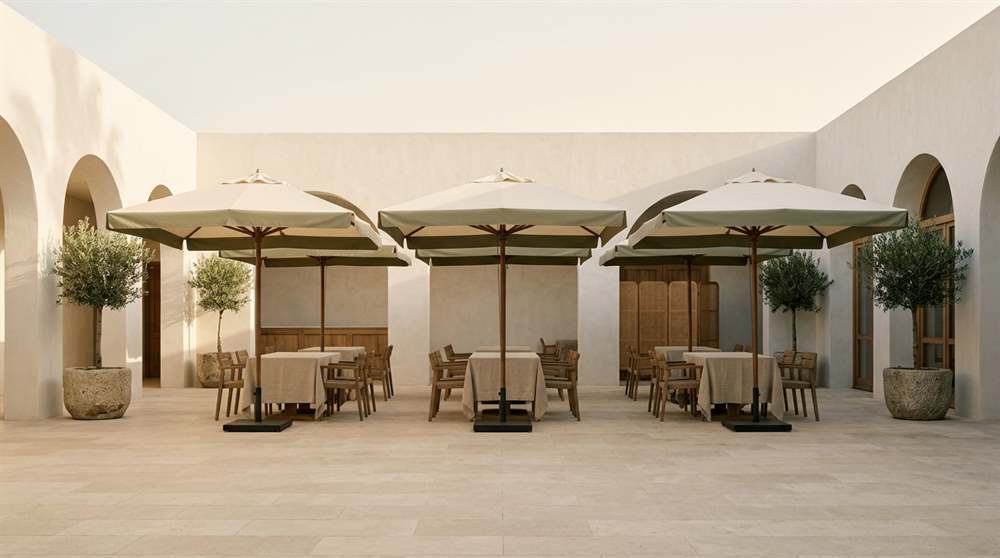
A heavy duty commercial umbrella is not simply a larger patio umbrella. The difference sits in the pole gauge, the rib section, the fabric weight and the base mass, and it usually shows up in the second season rather than the first. Restaurant groups, hotel terraces and beach clubs that replace bent ribs every spring are almost always running residential-grade frames under commercial use. This guide sets out the four measurements that decide whether a frame is genuinely heavy duty, how the leading shade brands position their own heavy duty ranges, and how to specify one that holds in your wind load.
What Makes a Commercial Umbrella Heavy Duty
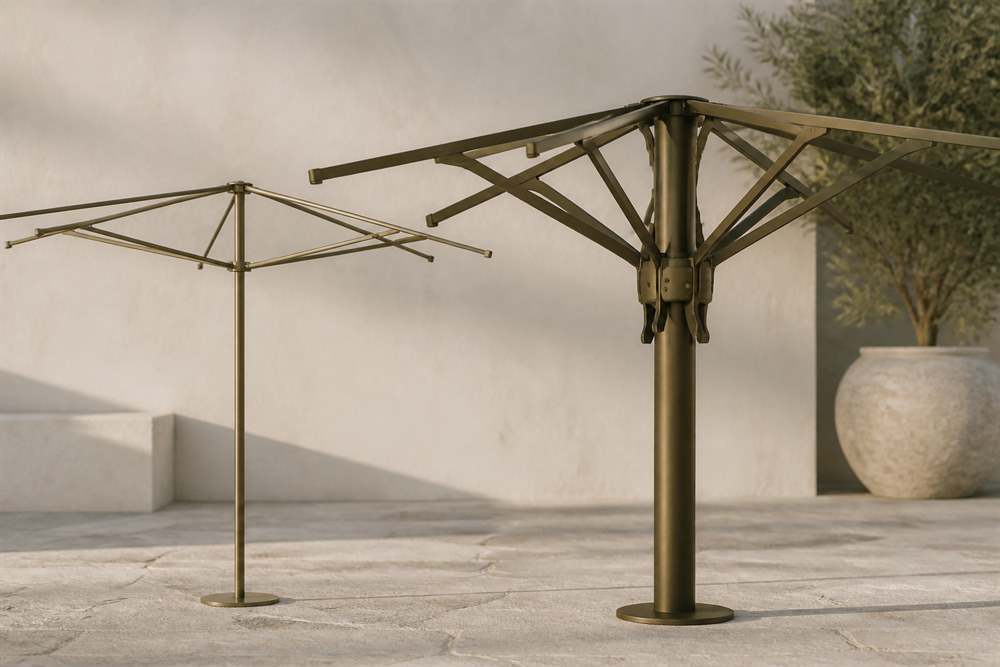
Four measurements separate a commercial frame from a residential one, and none of them is canopy size.
1. Pole diameter and wall thickness
A residential center pole is usually around 38 mm. Commercial frames run 48 mm and 67 mm, and the largest structures go to 80 mm, 86 mm and 100 mm. Diameter alone does not tell you much: a 48 mm pole with a thin wall is weaker than the same diameter with a heavier one. Ask for the wall thickness in millimeters, not just the pole size.
2. Rib section
Ribs are quoted as two numbers, for example 10 x 18 mm or 20 x 30 mm. The deeper number is the one that resists bending. A 10 x 18 mm rib belongs on a garden umbrella. Commercial canopies carry ribs from roughly 14 x 24 mm up to 35 x 22 mm, with the heaviest sections reserved for the widest spans.
3. Fabric weight and coating
Canopy fabric is quoted in grams per square meter. Light garden canopies sit near 180 g. Commercial canopies are commonly specified between 220 g and 300 g, with PU or PA coating on the reverse, and solution-dyed acrylic where colorfastness matters most. A heavier fabric is not only more durable; it hangs straighter and lifts less in wind.
4. Base mass and geometry
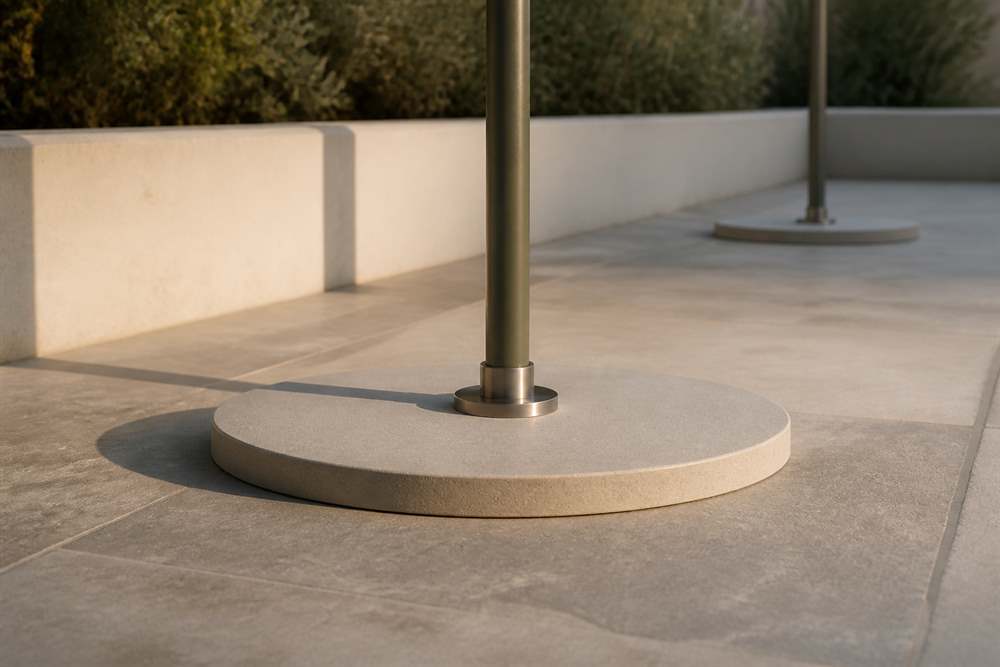
Holding power is base mass plus geometry. A heavy base on a short footprint still tips, while the same mass spread wider resists. On exposed sites the base belongs in the specification, not in the accessories list. Commercial umbrella bases are quoted by mass and by the ground they are designed for.
Frame and Ribs: Where the Weight Actually Goes
Most of what you pay for in this category is invisible from the terrace. Anodized aluminum is the default commercial material because it resists salt air and does not need repainting. Steel is stronger per millimeter and heavier; wood and wood-grain finishes carry the design intent but need more care in coastal air.
The failure point is rarely the pole. It is the hub and the rib connection, where every gust load concentrates. Ask a supplier for an industrial umbrella heavy duty rating and you will usually be handed a pole diameter; the rest of the answer lives in the hub and in the rib connection. Cast or machined hubs with a serviceable connection outlast pressed ones, and the difference is visible if you ask for the part rather than the picture.
This is where the top of the market competes. TUUCI, the American maker that sits at the high end of commercial shade, builds for hospitality, resort and architectural projects, including marine and yachting work where corrosion and wind are not negotiable. Poggesi, working out of Florence, builds commercial-grade wind-resistant extra large umbrellas and sells them into luxury contract projects. Neither brand is competing on canopy color. They compete on the frame.
The number that summarises the whole assembly. Look for the Beaufort wind scale figure a supplier publishes. Our commercial center pole ranges are rated to Beaufort 4 to 5, and that figure only means something when the pole, the ribs and the base are specified as one system.
Heavy Duty Commercial Patio Umbrellas: Sizing for Outdoor Dining
Heavy duty commercial patio umbrellas are usually bought in one of four size bands, and the band is set by the table plan rather than by the umbrella.
| Canopy size | Typical use | Frame starting point |
|---|---|---|
| 2.1 m x 2.1 m to 2.5 m x 2.5 m | Cafe tables for two to four, small terraces | 38 mm to 48 mm pole |
| Round 2.7 m to 3.0 m | Bistro and hotel pool sets | 48 mm pole |
| 3.0 m x 3.0 m to 3.0 m x 4.0 m | Restaurant patios, four to six covers per umbrella | 48 mm to 67 mm pole |
| 4.0 m x 4.0 m and above, up to 5.0 m x 5.0 m | Pool decks, event lawns, large commercial spans | 67 mm and up, cantilever or center pole |
Sizes and pole options across the range are listed on our large commercial umbrellas page, including 7.0 m x 7.0 m structures for open lawns.
Heavy Duty Commercial Umbrellas for Restaurants
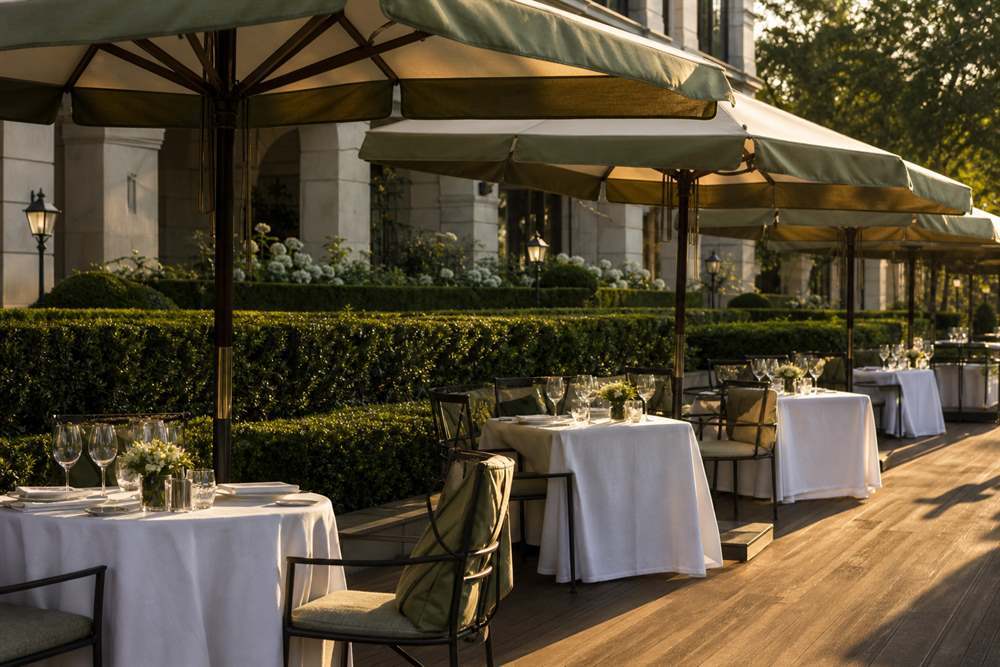
A restaurant is the hardest duty cycle in outdoor shade. The umbrella opens before service, closes after, and does it again the next day, all season, often by a staff member who has thirty of them to get through.
Two details decide whether that works. The first is the opening mechanism: a crank or push-pull system on a commercial frame is built for repeated cycles, while a cable system on a large span needs the better pulley to stay smooth. The second is fabric maintenance. A 250 g to 300 g coated fabric wipes clean and holds its color; a light fabric stains and fades in one season of food service.
The brands that dominate this segment got there on different arguments. Treasure Garden, the American shade supplier with four decades behind it, covers the market through sheer product breadth, with more than 25,000 shade options across its Simply Shade, Shademaker and Jardinico lines. Glatz, the Swiss manufacturer, argues precision instead: parasols built and rated for wind, UV and heavy commercial use. Frankford Umbrellas has been making commercial-grade umbrellas in the United States since 1898 and now supplies hospitality and resorts.
Where a restaurant group is choosing between these, the deciding factor is usually not the umbrella at all. It is whether the supplier can repeat the exact same specification for the next fifty units, two years later. That is a supply chain question, and it is covered further down.
Coastal and Beach Venues: Heavy Duty Commercial Beach Umbrella
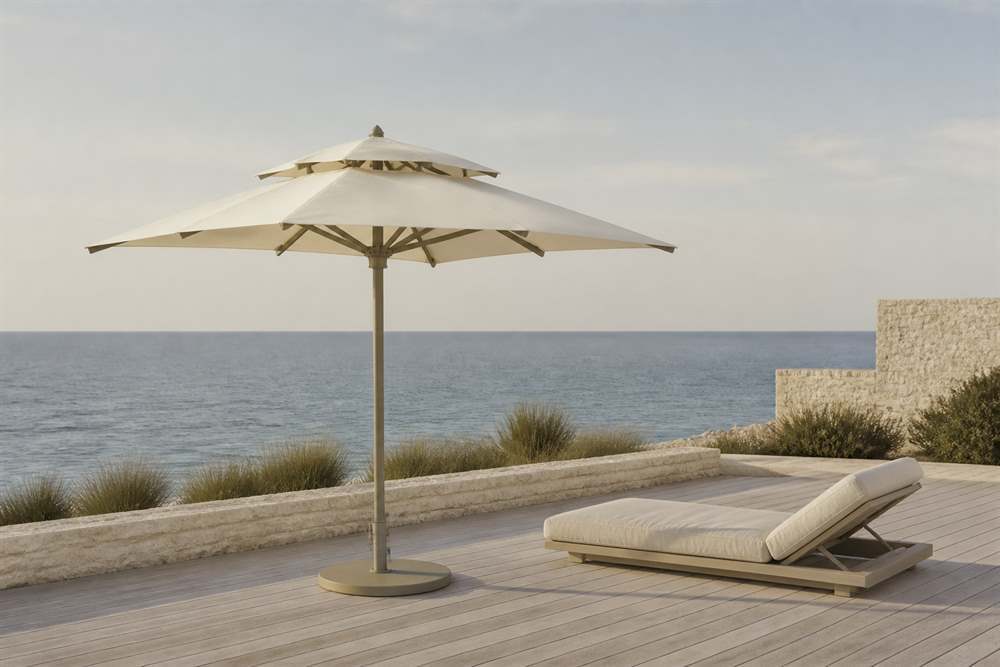
A heavy duty commercial beach umbrella works under a different load case. Wind arrives with nothing to break it, sand moves the base, and salt attacks every fitting. Three specifications matter most.
- Vented canopy. A wind vent or a double-tier canopy lets air pass instead of lifting the whole structure.
- Anodized frame and stainless fasteners. Coastal corrosion starts at fixings and cast joints, not at the pole.
- Base mass calculated for the exposure. A beach site needs the mass, and usually more than a terrace of the same size.
Brands here split by material identity. Bambrella supplies commercial-grade patio umbrellas to hotels, restaurants and country clubs and has built its identity on bamboo. Umbrosa develops and produces in Belgium, and is unusual in treating umbrella bases as a product category in their own right, alongside seven umbrella collections and shade sails. Scolaro is an Italian factory making parasols for gardens and outdoor areas with an Italian design language.
If your site is coastal, the frame and the base are the two places to spend the budget. Frame and structure can be specified in anodized aluminum with sealed joints, and base and mounting options range from fillable to in-ground fixing, which is the only arrangement that never tips.
How to Specify and Order
Specifying a heavy duty commercial umbrella is a short checklist, and doing it in this order avoids the expensive mistakes.
- Site and wind. Exposed or sheltered, coastal or inland, and the strongest seasonal wind the site actually sees.
- Table or seating plan. Canopy size and the number of covers each unit has to shade.
- Frame. Center pole or cantilever, pole diameter, rib section, finish.
- Fabric. Weight in grams, coating, color, and whether a brand color has to be matched.
- Base. Mass and mounting arrangement for the ground on site.
- Branding. Panels to be printed, artwork, and packaging. Color-matched cast parts are offered above 500 pieces.
Then ask for a sample before mass production, and agree the inspection points: pole wall thickness, rib section, hub construction, fabric weight and stitching, base mass. The specification is only worth what the inspection confirms.
Where Foris Hortus fits. Foris Hortus crafts these frames in its own production rather than buying them in, and that is the difference between a specification and a catalogue entry. The size and frame bands run from 2.1 m x 2.1 m to 7.0 m x 7.0 m, with 38 mm to 100 mm poles, rib sections from 10 x 18 mm to 35 x 22 mm, fabrics from 180 g to 300 g, and Beaufort 4 to 5 wind ratings on the commercial center pole range. Because the structure is made in-house, the same specification can be repeated across later orders, and the canopy, the valance and the handle can carry your own artwork. Aesthetics and structure are settled together, which is the only way a tailored shading programme stays coherent across a whole terrace rather than looking like a collection of umbrellas. For a wider view of the market, our review of the best outdoor umbrella brands looks at TUUCI, Treasure Garden, Glatz and Bambrella in more detail.
Frequently Asked Questions
Is a heavy duty commercial umbrella the same as a large commercial umbrella?
No, and the two are often confused. Size is the span of the canopy. Duty is the frame, the fabric and the base. You can buy a large umbrella on a light frame, and it will fail sooner than a smaller one on a heavy frame, because a wider canopy catches more wind.
What fabric weight should a heavy duty commercial patio umbrella have?
Between 220 g and 300 g per square meter for commercial service, with PU or PA coating. Below 200 g is garden territory. Above 300 g the fabric becomes hard to handle and slow to dry.
Can a heavy duty commercial beach umbrella stay up in coastal wind?
Yes, if three things are true: the canopy is vented, the frame is anodized with stainless fixings, and the base mass is calculated for the exposure. A coastal site generally needs a heavier base than an inland terrace using the same umbrella.
What base mass does a heavy duty commercial umbrella need?
It depends on the canopy size, the exposure and the mounting. A fillable base filled on site, a granite or concrete base, and an in-ground sleeve all reach different holding power at different weights. Fix the mounting arrangement first, then size the mass.
Do you print logos on heavy duty commercial umbrellas?
Yes. Canopy printing is placed around the panels, in up to eight positions, by silk screen or digital printing, with printed handles and cartons as options. Our customization pages cover the panel positions and the printing methods in detail.
How many covers can one heavy duty commercial umbrella shade?
It depends on the canopy and on the service style. On restaurant layout figures of 12 to 18 square feet per diner, a 3 x 3 m canopy suits 5 to 8 covers and a 5 x 5 m canopy spans 14 to 22. That is why heavy-duty commercial patio umbrellas are chosen size by size against the seating plan rather than by pole specification alone. The shade coverage and seat calculator on our size and shape customization page runs the same figures for every canopy from 2.1 x 2.1 m to 6 x 6 m.
Where This Leaves Your Specification
Pole gauge and wall thickness decide how the load travels. Rib section decides whether the canopy stays flat in a gust. Fabric weight decides how the canopy ages. Base mass and geometry decide whether the whole thing stays where you put it. Read the four together and a specification becomes comparable; read one of them alone and you are buying a number rather than a shade structure.
For a project the useful sequence is to fix the site and the seating plan first, then the frame, then the fabric and the base. Decisions made in that order hold together across a whole terrace, which is what separates bespoke shading from a collection of umbrellas.