Corporate Parasols and Printed Umbrellas: How Hotels and Restaurants Brand Their Shade
- Share
- Issue Time
- Oct 8,2026
Summary
A guide to branded parasols for hotels, restaurant groups and resorts: where a logo can be printed, silk screen versus digital, how a brand colour is matched, and what the minimum order and lead time look like.
The short answer
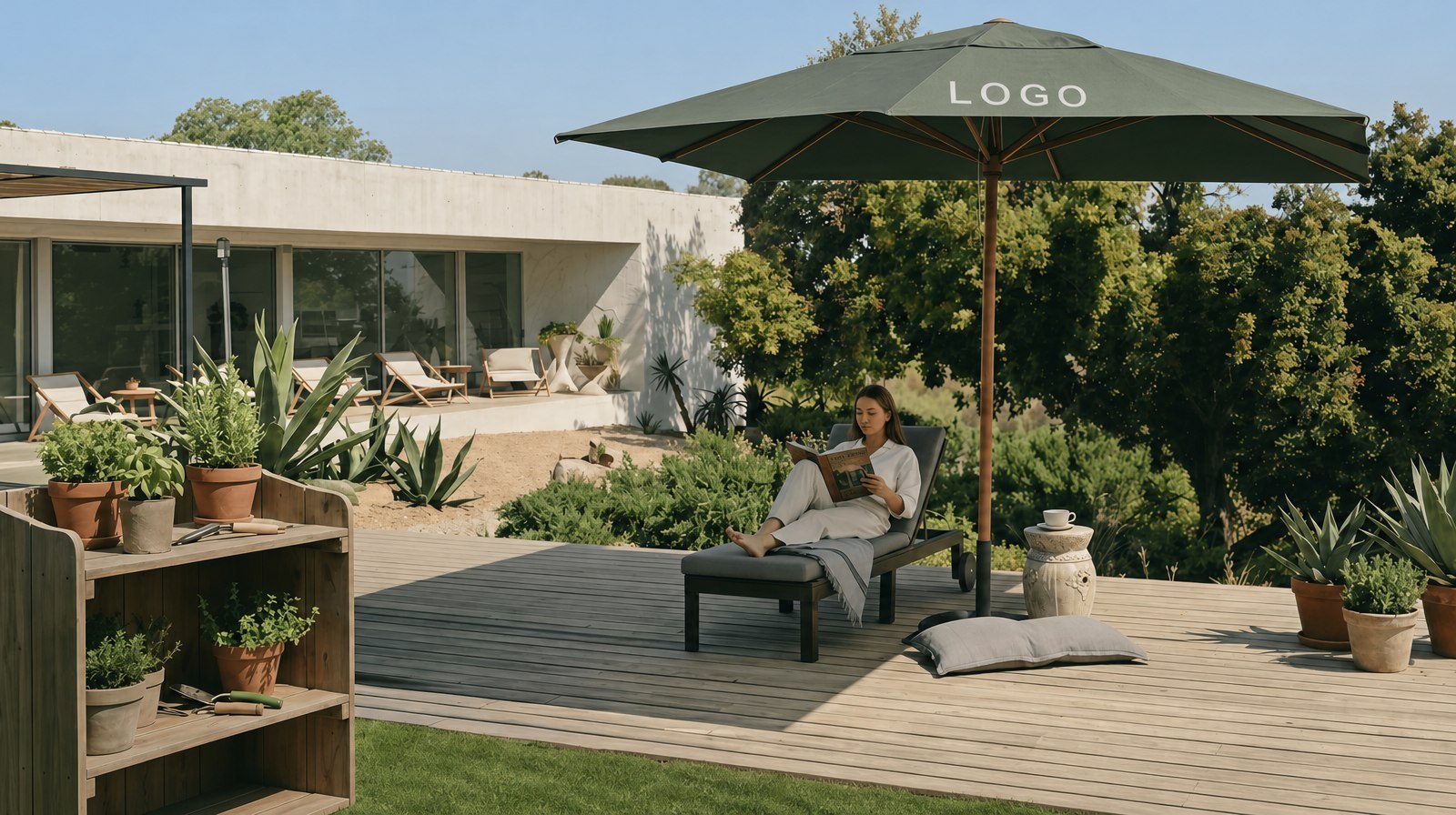
A corporate parasol is an outdoor umbrella whose canopy carries a customer logo. The print sits on the fabric itself, so it is read at eye level on every terrace the umbrella stands on, and it adds no hardware, no sign and no separate fixing to the site.
Printing is placed around the canopy in up to eight positions, by silk screen or digital printing, and the same reference can be carried onto the pole, the handle, the cast metal parts above 500 pieces and the packaging. Minimum order starts at 50 pieces for a catalogue model and moves to 100 pieces once the cloth colour is matched to your reference and a logo goes on it.
If you are specifying a branded run, send four things: vector artwork, a Pantone or RAL reference, the canopy size and shape, and the panel numbers you want printed. Everything after that is proofing.
What a printed canopy does that a sign does not
A hotel, a restaurant group and a resort already own the shade. The canopy is the one large, clean, evenly lit surface on the terrace, it faces the guests all day, and it is replaced on a known cycle rather than on a marketing budget.
Four things follow from that:
- The mark is read at the height people actually sit at, not above their heads on a wall.
- A block of umbrellas repeats the same mark across the whole terrace, so the brand reads from the far end of the site without extra spend.
- The print is on an item that was being bought anyway. Nothing is added to the site to carry it.
- The identity holds through a refurbishment, because the umbrellas are usually specified before the loose furniture and the planting.
The one thing a printed canopy cannot do is change cheaply. The print position and the cloth colour are settled before the fabric is cut, so the specification is worth a second look before production starts.
The four decisions that shape a printed canopy
Everything else is downstream of these four, and all four are settled at enquiry rather than at production.
1. Where the print sits on the canopy. 2. How many panels carry it. 3. How large it prints on the panel. 4. Which printing method is used.
Where a logo can go
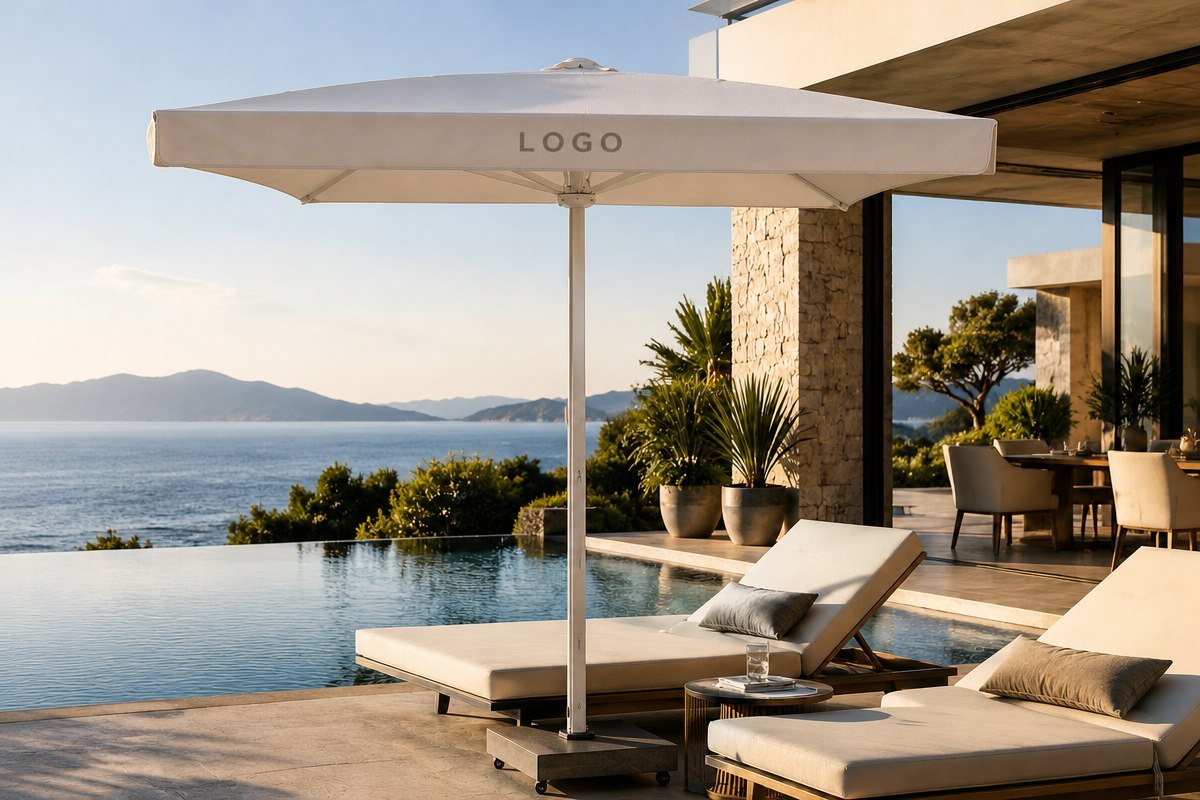
Six placements cover almost every order, and each one is planned before the fabric is cut so that the mark reads correctly from the seating side.
| Position | What it carries | Notes |
|---|---|---|
| Canopy panels 1 to 8 | The main mark, printed on any single panel or right around all eight | Reading direction confirmed on a layout before cutting |
| Valance, along the bottom edge | One line on the hanging edge, visible from the seating side | Suits a wordmark rather than a stacked lockup |
| Crank handle face | A small mark on the handle | Seen every time staff open the umbrella |
| Hub, finial and cast parts | Colour matched aluminium rather than printed | Offered above 500 pieces |
| Pole | Wrap print or powder coat in the same frame colour | Extends the identity down to seat height |
| Carton and sticker | Colour box, self-adhesive sticker or full colour printing | For retail and for projects that unpack on site |
The canopy carries most of the branding, and it is where the decision matters most. Everything below it, from the pole to the carton, is a way of holding the same reference on the way down. The full set of specification options, and the minimum order that goes with each one, is set out on the logo and branding page.
Silk screen or digital printing
The two methods are not interchangeable, and the choice is decided by the artwork and the run length rather than by price alone.
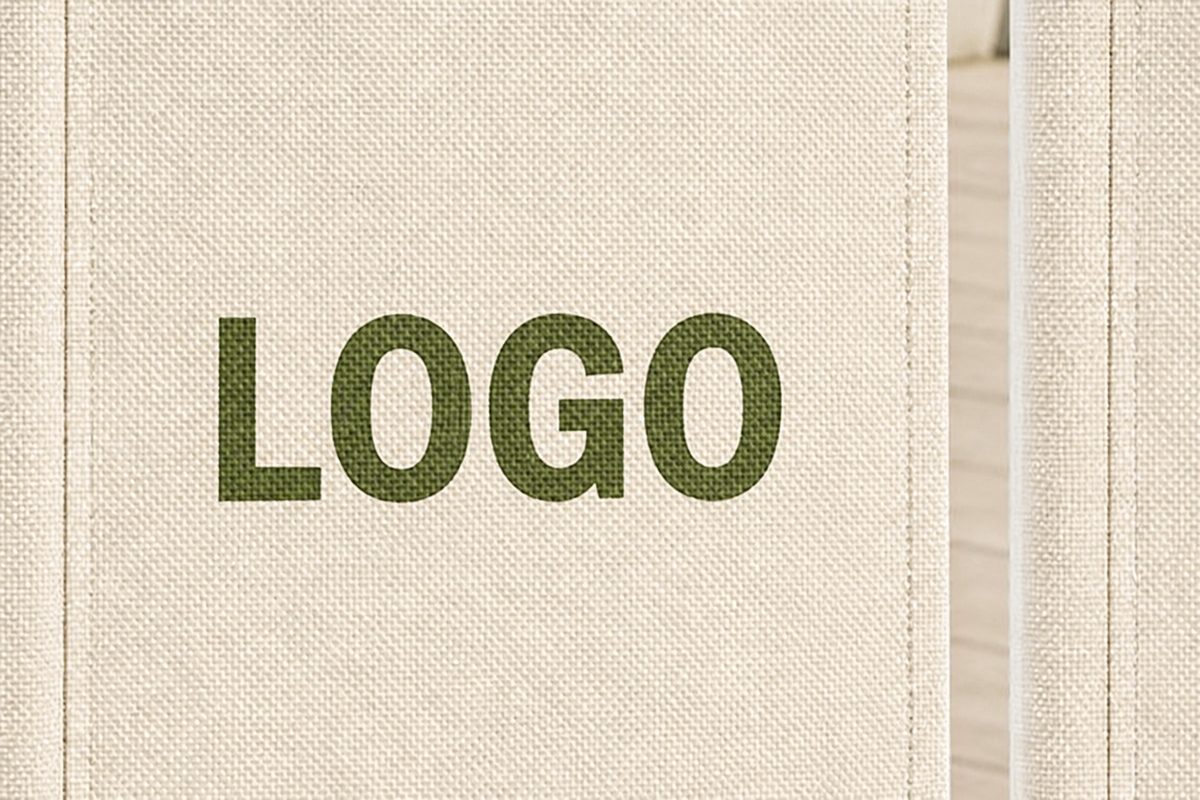
Silk screen lays a flat, opaque film of ink. It is the right choice for a solid spot colour, which is what most hotel and restaurant marks are, and it holds its edge across repeat orders because the screen is made once and reused.
Digital printing reproduces blended detail and gradients, and it does not need a screen per colour. It suits shorter runs and artwork with fine or photographic detail.
A practical rule: if the mark is one or two flat colours and the order will repeat, specify silk screen. If it has gradients, soft edges or many colours, or if the run is short, specify digital. If the print will face full sun or be cleaned often, say so at enquiry, because the ink and the fabric are then specified together rather than separately.
What the print has to survive
A printed canopy lives outdoors in sun and in weather, and it gets cleaned along with the rest of the terrace. Three things decide how long the print keeps reading correctly.
The cloth underneath
Print sits on the fabric, so the fabric sets the ceiling. Canopies are quoted at colour fastness EU standard 6 and US 4, with a PU or PA coating and a UV index from uv30 to uv80. On a terrace that sees full sun all day, ask for the higher UV figure and a yarn dyed cloth.
The ink system
A flat opaque ink holds its edge better than a thin one, which is one reason silk screen suits solid spot colour. Where a canopy faces the afternoon sun for months, the ink is specified against the cloth rather than on its own.
Where the panel faces
A print on a panel that takes full sun all afternoon fades before one that sits under a valance. Sending the orientation of the terrace and the hours of direct sun is more useful than sending the artwork alone.
Matching a brand colour
Colour is where a branded order is most often held up, and it is the easiest step to get right.
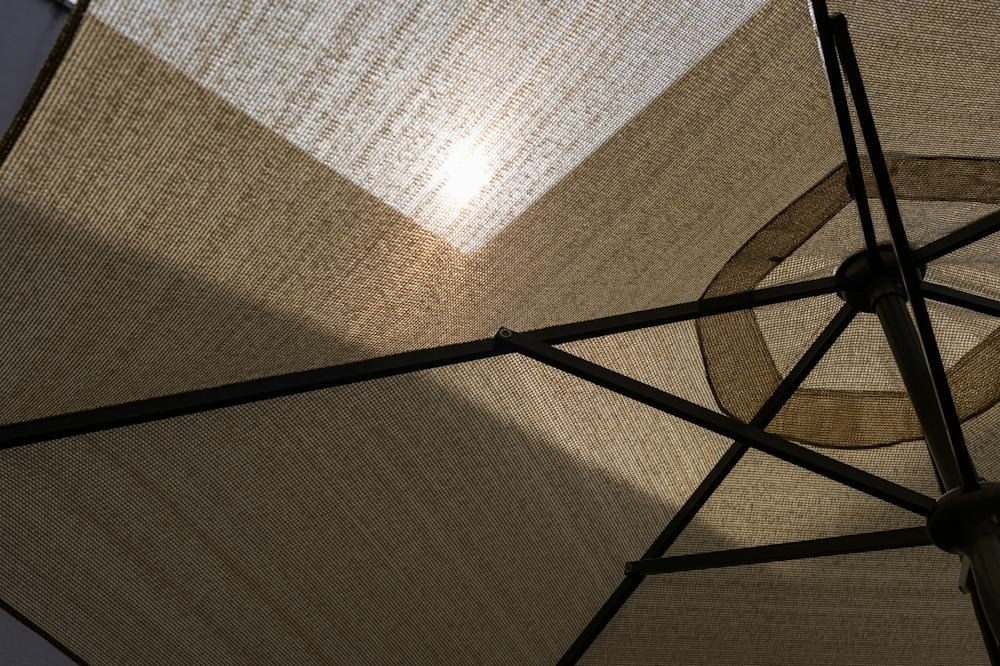
Send a Pantone or RAL reference. A dyed swatch, the lab dip, is submitted for approval before production, and the approved dip is kept on file so that a repeat order matches the first batch rather than the first sample. Where the cloth colour, the coating or the UV figure is being chosen at the same time, the fabric and colour page covers those options in the same order of decisions.
Two habits avoid most of the trouble:
- Never approve a colour from a screen. Monitors vary, and woven cloth shifts a tone once it is dyed.
- Keep the approved dip on file. A site that is expanded in year three should match year one.
Where the frame is being matched as well, the pole and the cast aluminium parts move to the same reference. Colour matched cast aluminium is offered above 500 pieces; below that the frame stays in the standard finish.
Which umbrellas take branding
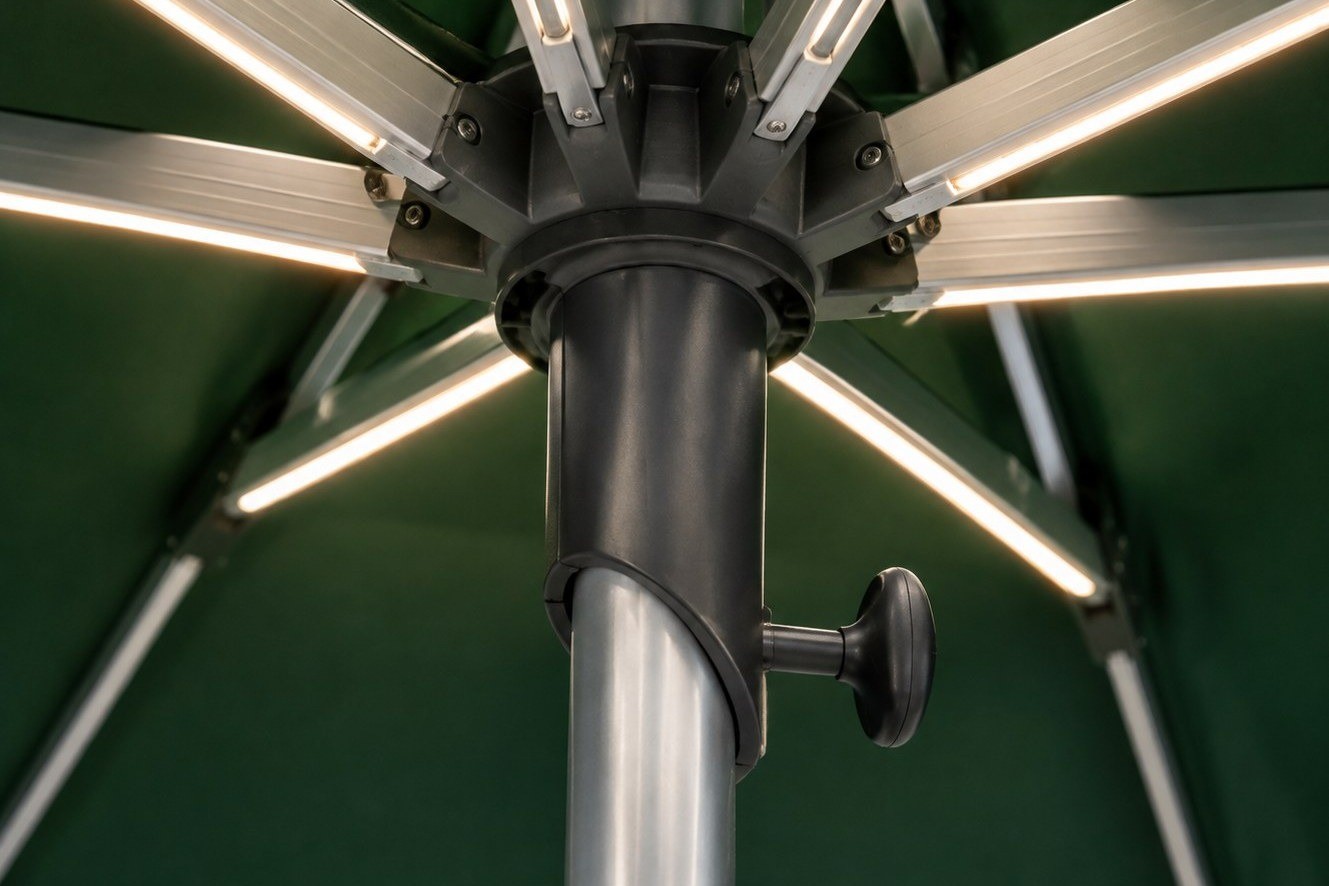
Ten models across the umbrella range carry a logo specification. These six cover all three structures and show what each one can carry. The size shown is the standard range for the model, and every model can also be quoted in a custom size.
| Model | Structure and size | Pole and ribs | Fabric | Where the logo goes |
|---|---|---|---|---|
| Centre pole | 2.5 m to 4 m | Pole 48 x 1.8 mm, 8 ribs | 280 g yarn-dyed | Canopy corners and valance |
| Roman centre pole | 2.1 x 2.1 m and 3 x 3 m | Pole 48 x 1.2 mm, ribs 14.5 x 24 x 1.0 mm | 250 g with PA coating | Canopy corners and valance; LED optional on the same frame |
| Commercial centre pole | 3 x 3 m to 5 x 5 m | Pole 86 x 86 x 2.4 mm, ribs 25 x 33 x 1.5 mm | 300 g with PA coating, UPF 50+ | Canopy corners and valance; crank handle and 360 degree swivel |
| Centre pole, wood-grain | 3 x 3 m to 3 x 4 m | Pole 58 x 1.5 mm wood grain, ribs 14 x 24 x 1.0 mm | 250 g with PA coating, UPF 50+ | Canopy |
| Side pole, crank and tilt | Standard commercial size | Pole 65 x 65 x 2.0 mm, ribs 18 x 30 x 1.0 mm | 250 g with PA coating, UPF 50+ | Canopy, corners and pole |
| Large Roman | 3 x 4 m to 5 x 5 m | Reinforced cast aluminium frame, gas-spring opening | 250 g to 300 g | Canopy corners and valance |
Four of these are centre pole, one is side pole and two are Roman, so a site can hold the same mark across a courtyard, a pool deck and a dining terrace without changing supplier or specification.
Three of them are worth a closer look:
- Premium aluminium centre pole umbrella with push-pull operation carries eight ribs and a 48 x 1.8 mm pole, which is what lets the same mark repeat right around all eight panels.
- Premium commercial LED centre pole umbrella runs 3 x 3 m to 5 x 5 m on an 86 x 86 x 2.4 mm pole with 300 g fabric, and takes a printed canopy with a crank handle and 360 degree swivel.
- Cantilever umbrella with adjustable tilt on a 65 x 65 x 2.0 mm pole is the one whose customisation covers the canopy, the corners and the pole itself.
Choosing by situation rather than by price
Most branded orders are decided by the situation on the terrace, not by a specification sheet. These are the combinations that come up most often.
| The situation | What is usually specified | Why |
|---|---|---|
| Hotel or restaurant group, repeat units | Screen printing in a standard colour | The screen is made once and held, so repeat orders match |
| The brand colour must match exactly | Lab dip approval on a brand colour | The cloth is dyed to the reference before printing |
| A one-off event or a short run | Digital printing | No screen per colour, so a short run stays economic |
| Detail work on the handle or the valance | Printed handle plus trim | The mark is read at the height people touch |
| Retail-ready presentation | Colour box, sticker, colour printing | The carton leaves the warehouse as part of the product |
| Frame colour matched to the brand | Cast aluminium matched, from 500 pieces | The metal parts move to the same reference as the cloth |
Two of these are worth a note. A group that runs the same specification across several properties should specify silk screen and keep the approved lab dip on file, because that is the combination that makes year three match year one. A property that is branding for a single season, or for one event, is usually better served by digital printing on a stock cloth colour.
A panel mark or a valance line
The two most common placements do different jobs, and they are not alternatives so much as a pair.
A panel mark is the main logo, sized to the panel that faces the seating side. It is what a guest reads when they look up from the table, and it is the placement that carries a stacked lockup, a crest or a full wordmark. On a model with eight ribs, the same mark can be printed right around all eight panels, which is what makes a group of umbrellas on a hotel terrace read as one identity from the far end of the site.
A valance line is a single line on the hanging edge below the canopy. It reads from the seating side, it suits a plain wordmark, and it is the placement that survives being looked at from directly underneath. Where the terrace is also seen from a first-floor window or a balcony, the valance is the surface that carries the mark from above, because the canopy itself is angled away from that view.
Where both are specified, the artwork is normally supplied as two files: the panel lockup and a single-line version of the wordmark. That keeps the valance legible at a smaller size rather than shrinking the panel artwork until it stops reading.
Preparing a branded order
Four steps take a brand guideline to a printed canopy. The order matters: colour is approved before the print.
1. Send artwork and reference. Vector logo, colour reference and the panels you want printed. A sketch of the reading direction helps. 2. Approve the print proof. Position, print size and colour are confirmed on a layout before anything is cut. 3. Approve the physical sample. A dyed swatch and a printed sample are submitted, because screens vary and cloth changes a colour. 4. Lock the packaging. Cartons, stickers and inner protection are set to the retail or project requirement.
The fastest route to a printed canopy is approving the print layout and the colour reference at the same time. Where they are approved separately, the sample clock restarts each time the specification changes.
What to send with the enquiry
- Vector logo and colour reference
- Canopy size and shape
- Panels to print, or the valance, or both
- Printing method, if you have a preference
- Packaging requirement, if the carton is branded
With those five items, print, colour and packaging can be confirmed in one reply rather than three.
Do and avoid
Avoid approving a colour from a screen. Monitors vary and woven cloth shifts a tone, so the lab dip is what gets approved.
Avoid cutting fabric before the print position is signed off. Repositioning after cutting is a new canopy, not an adjustment.
Do send vector artwork and a colour reference, plus the panel numbers you want printed. A panel number is unambiguous; "the front" is not.
Do keep the approved lab dip on file, so a later repeat order matches the first batch rather than the sample.
Where the mark goes on each structure
The structure decides which surfaces are available, so it is worth settling before the artwork is drawn.
On a centre pole umbrella the canopy radiates from the pole, and the number of ribs sets the number of panels. An eight rib canopy gives eight panels, which is what allows the same mark to be printed right around the umbrella rather than on one face. The centre pole models carry the logo on the canopy corners and the valance, and the commercial centre pole adds a printed crank handle face, so the mark is seen when staff open the umbrella as well as when guests sit under it.
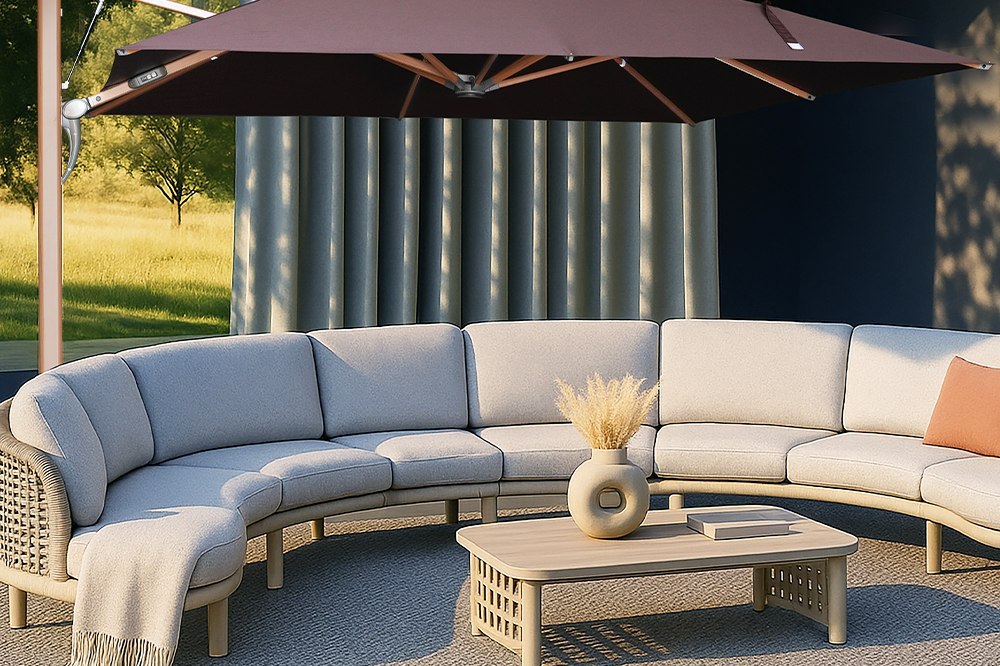
On a side pole or cantilever umbrella the canopy hangs from one side and the pole stands clear of the seating. That leaves the pole as a free vertical surface at seat height, and it is the one structure in the range whose customisation covers the canopy, the corners and the pole together. On a terrace where guests walk past the pole to reach the seating, that is the surface that gets read most often.
On a Roman umbrella the canopy is built in two tiers on a reinforced frame, and the branding sits on the canopy corners and the valance in the same way as a flat canopy. Roman models are usually the widest in the range, which means the same wordmark prints larger at the same panel position, and the valance line runs further than it does on a smaller canopy.
A wood-grain centre pole is specified with the branding on the canopy rather than the pole, because the pole carries the wood-grain finish. Where a site wants the identity to continue down to seat height on that model, the answer is the valance line and the cast parts rather than a pole print.
Minimum order and lead time for a branded order
The minimum depends on how much of the umbrella changes, not on how many you want in total. Catalogue models start at 50 pieces. Once the cloth colour is matched to your reference and a logo goes on it, the minimum moves to 100 pieces.
| What is being customised | Minimum |
|---|---|
| Catalogue model, no change | 50 pcs |
| Light customisation: Pantone fabric colour, logo by screen print or heat transfer, custom handle | 100 pcs |
| Printed cartons | From 200 pcs |
| Structural: new size or shape, frame structure, base mounting, integrated LED | 300 pcs |
| Full OEM or ODM | Quoted per project |
Two things bring the minimum down: sharing one fabric colour across several models, and repeating a specification that has already been run. Colours and models can be mixed inside a single catalogue order.
Lead time
Stock models are produced in about 30 days. Where the fabric, the colour or the branding is custom, add around 10 days. A pre-production sample starts its clock when the specification is approved, so the fastest route to a printed canopy is approving the print layout and the colour reference together.
Port to port, sailing takes about 18 to 25 days to the US West Coast, 30 to 35 days to the US East Coast and Northern Europe, 18 to 22 days to Jebel Ali and 15 to 20 days to Australia. From March to July, container space is worth booking about four weeks ahead. Chinese New Year closes production for around two weeks.
A branded order therefore has a season as well as a lead time. A terrace that has to be dressed before a spring opening is specified in the winter, not in the spring.
Packaging that carries the brand
The carton is part of the order for any project that unpacks on site in front of a client. Colour boxes, self-adhesive stickers and full colour printing on cartons are all available, with reinforced outer cartons for export.
For a group that receives deliveries at several properties, branded packaging is also what keeps a mixed consignment readable on arrival: the carton identifies the specification, the property and the model before anything is opened.
After the order: replacement and repeat
A printed canopy is not a one-off. Replacement canopies are made to the original size, fabric and colour, and the standard ranges stay available for five years after purchase, with common parts shipping in about seven days. A branded canopy damaged in year three is replaced to match the rest of the site rather than re-branded from scratch.
That is the reason the lab dip is kept on file. It is also the reason a group that expands a terrace in year two should stay with the same model rather than switch to whatever is cheapest that season: the identity is held by the whole set, not by the new umbrellas.
Questions buyers ask
Can a logo be printed on every panel? Yes. Up to eight positions per canopy, in silk screen or digital printing, with the reading direction confirmed on a layout before production.
How is a brand colour matched? Send a Pantone or RAL reference. A lab dip swatch is submitted for approval and kept on file for repeat orders.
Which printing suits a smaller order? Digital printing, because it does not need a screen per colour and handles detailed artwork on shorter runs.
Can the packaging carry the brand? Yes. Colour boxes, self-adhesive stickers and colour printing on cartons are all available, with reinforced outer cartons for export.
What size run do we need for a printed handle? Printed handles sit inside the light customisation band, which starts at 100 pieces once the cloth colour is matched and a logo is going on the canopy.
Does the frame colour have to change too? No, and most orders leave the frame in the standard finish. Where the pole and the cast parts are matched to the brand as well, that is offered from 500 pieces.
Can one order cover several properties? Yes. Colours and models can be mixed inside a single catalogue order, and sharing one fabric colour across the models in the group is one of the two things that brings the minimum down.
What happens if a canopy is damaged later? A replacement canopy is made to the original size, fabric and colour. Standard ranges stay available for five years after purchase, with common parts shipping in about seven days.
Can the pole carry the logo as well as the canopy? Yes. The pole can be printed or powder coated in the same frame colour, and on the cantilever model the pole is part of the standard customisation. On a wood-grain pole the branding stays on the canopy.
What artwork format is needed? Vector artwork, so the mark scales to the panel without losing its edge, plus a Pantone or RAL reference and the panel numbers you want printed.
Can a stock size carry a printed logo? Yes. A catalogue model with a logo printed on it sits in the light customisation band rather than the no change band, because the cloth colour and the print are both specified at that stage.
The houses that set the standard for branded shade
Buyers comparing commercial shade usually end up looking at the same four names: TUUCI, Treasure Garden, Glatz and Bambrella. Each leads on a different strength, and for a project that needs a printed canopy that difference matters more than a specification sheet suggests.
- TUUCI leads on architectural engineering. Large-format canopies are built as structures rather than accessories, and customisation is specified per project, covering size, shape, finish, fabric, accessories and lighting.
- Treasure Garden leads on breadth. The catalogue runs from centre pole and tilt umbrellas to cantilevers and large-format models, so one site can specify a different umbrella for each zone without leaving the range.
- Glatz leads on engineering plus usability. The mechanism is as considered as the frame, which is what makes a large canopy easy to live with day to day.
- Bambrella leads on material identity, building bamboo, aluminium and stainless steel into a look that is recognisable across a whole collection.
What the four have in common is that the mark is treated as part of the specification rather than an after-sale option. On an order at this level, the logo sits on the same sheet as the frame finish, the fabric and the base, and the route to it is usually a dealer or a project specification rather than a stock purchase.
The practical question for a buyer is therefore not which of the four is best. It is which level of the market the project actually sits in. A landmark space justifies architectural shade and project pricing. A hotel courtyard, a restaurant terrace or a garden centre range usually needs the same printed-canopy capability without the project lead time.
Read the full engineering comparison of these four brands, including how each one handles frame, rib, hub and mechanism design.
Where Foris Hortus fits into a branded order
Between an entry-level patio umbrella and a highly specialised architectural shade system there is a substantial middle ground: well-engineered, customizable, commercially practical and contemporary in design. That is the space Foris Hortus occupies, and it is also where most branded terrace orders actually land.
Concretely, that means a printed canopy is quoted from 100 pieces rather than by project. The print sits on the canopy panels and the valance, the pole, the handle and the cast aluminium parts can carry the same reference above 500 pieces, and the carton can be branded for a property that unpacks on site in front of a client. Ten models across the range carry a logo specification, across centre pole, side pole and Roman structures, so one identity can be held across a courtyard, a pool deck and a roof terrace.
Custom size, colour and logo are quoted under OEM and ODM, which is what lets a group run one specification across several properties without a new drawing each time.
Questions to put to any branded-shade supplier
- How many print positions does the canopy take, and who confirms the reading direction?
- Is the print silk screen or digital, and why is that the right method for this artwork?
- How is the brand colour approved, and is the approved dip kept on file for repeat orders?
- Which surfaces beyond the canopy can carry the mark, and from what quantity?
- If a canopy is damaged in year three, is the replacement matched to the original?
The answers separate a supplier who prints umbrellas from one who can hold an identity across a terrace for the life of the scheme.
Branded shade, specified once
A corporate parasol order is a short list of decisions: where the print sits, how many panels carry it, how large it prints, which method is used, and which reference the cloth is dyed to. Get those five right before the fabric is cut and the rest of the order, from the pole to the carton, follows the same reference down.
Foris Hortus prints logos on umbrellas for hotels, restaurant groups and resorts, and matches canopy and frame colours to a brand reference.
Send the vector logo, the colour reference, the canopy size and shape, and the panels you want printed, and a print layout comes back with the specification and the quotation.
Start here: Logo and branding on an outdoor umbrella, logo customization, fabric and colour customization, size and shape customization and base and mounting options.
Reading next: how TUUCI, Treasure Garden, Glatz and Bambrella compare on engineering.
Models that take branding: the premium centre pole umbrella, the commercial LED centre pole umbrella, the commercial cantilever with adjustable tilt and the large Roman umbrella.
Browse the range: outdoor umbrellas, large commercial umbrellas and cantilever umbrellas. Questions on a specification can also go through the FAQ.