Commercial LED Umbrellas: How to Specify Lit Shade That Survives the Second Season
- Share
- Issue Time
- Sep 28,2026
Summary
A specification and procurement guide to commercial LED umbrellas: how the light is built into the frame, which power source suits which site, what to ask for in a quotation, how the numbers on a lighting spec should be read, and what happens after the purchase order.
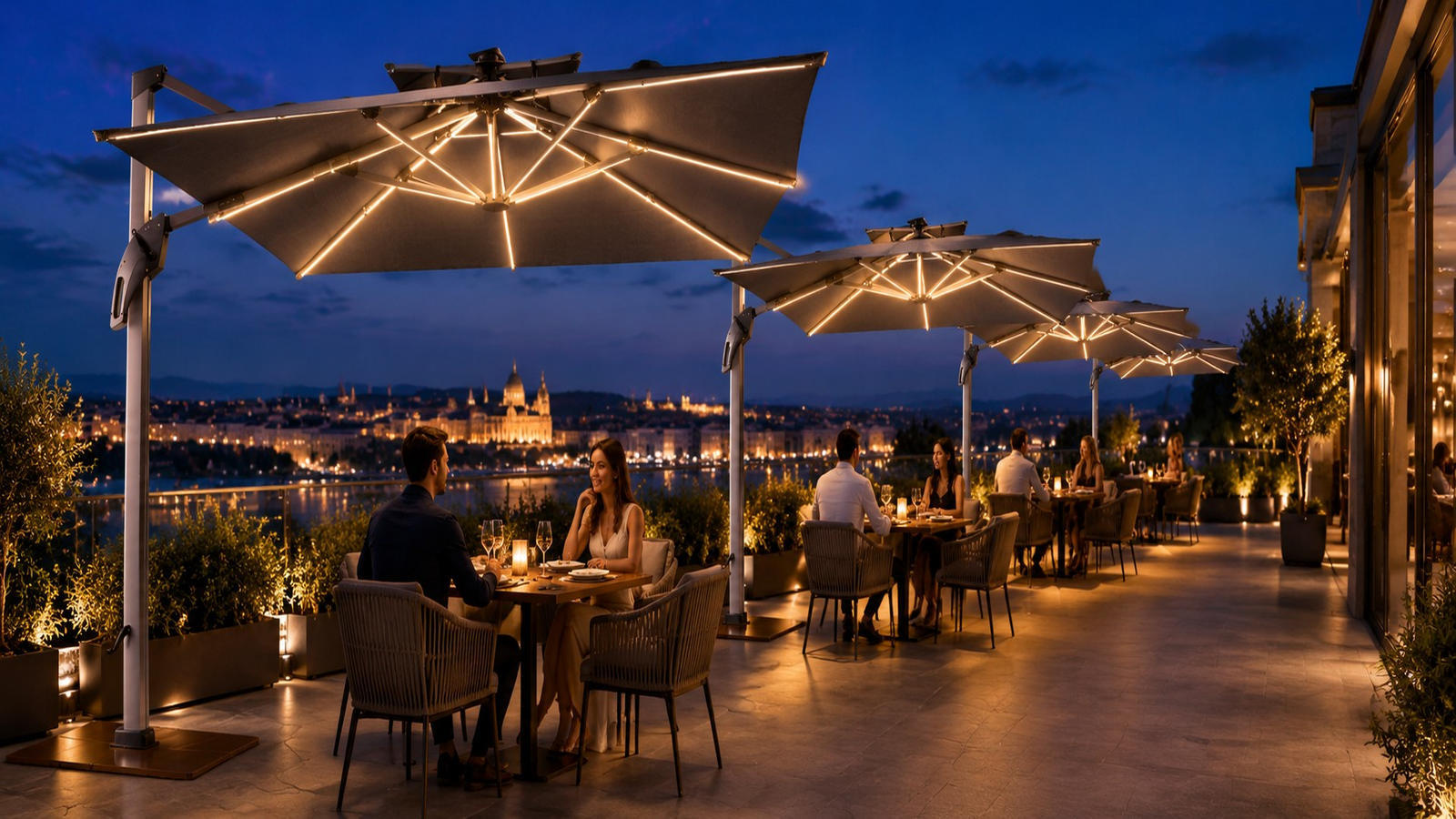
An umbrella that only works in daylight leaves half the terrace unused. On a hotel terrace, the evening service is often the profitable one, and the difference between a terrace that opens at six and one that closes at six is a lighting decision made months earlier, at the quotation stage.
This guide is about the number that actually decides the outcome, not the marketing claim. We build LED and solar umbrellas with the lighting integrated into the ribs rather than bolted on, in centre pole, cantilever and Roman frames. What follows is how those units are specified, where they go wrong, and what to check before you commit to a terrace-wide rollout.
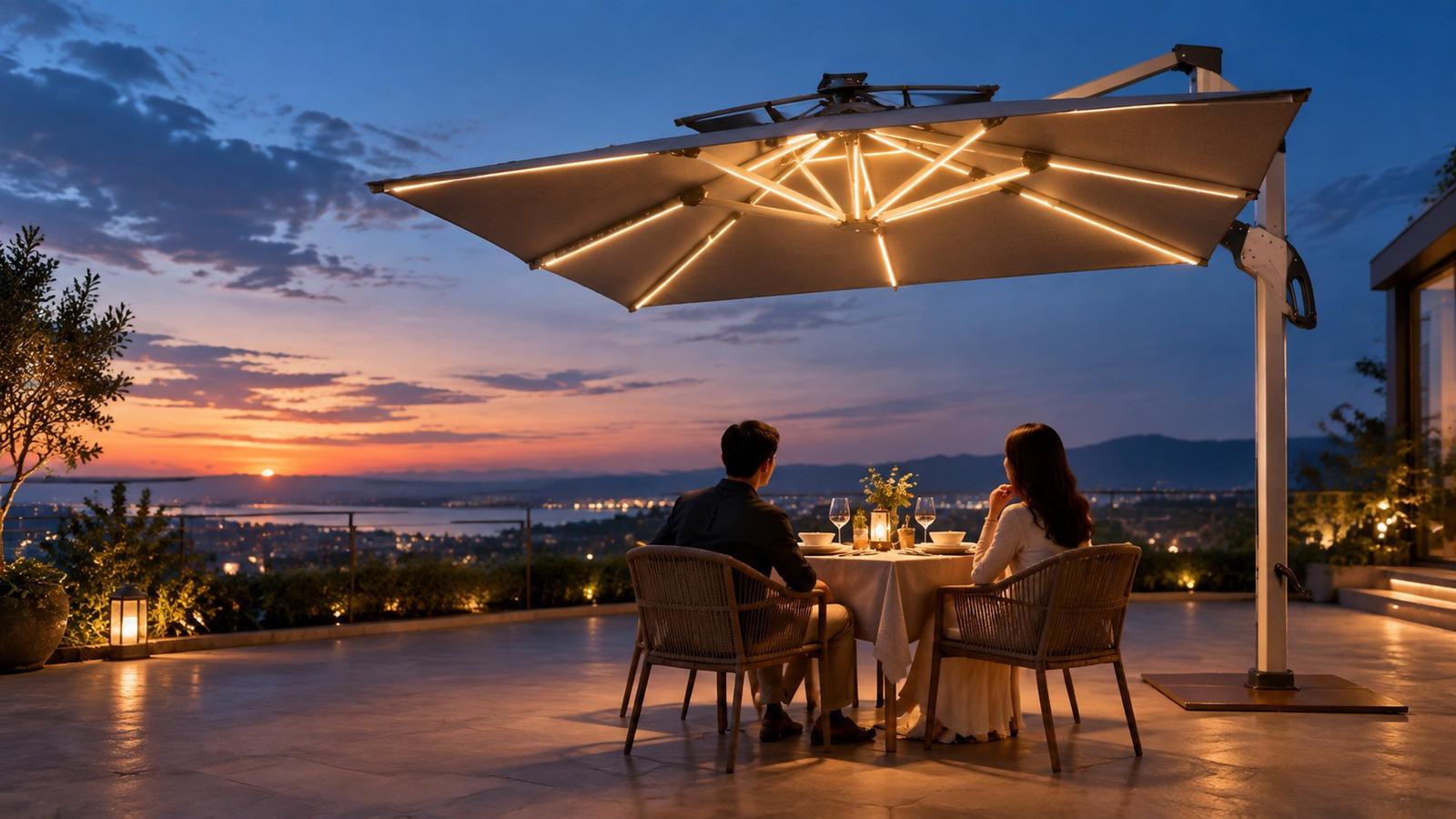
The short answer
Three things decide whether a lit umbrella works on a commercial terrace:
- Where the power comes from. Solar suits open, sunny sites. Shaded courtyards, indoor-adjacent terraces and cloudy regions need mains power or a rechargeable battery pack. Get this wrong and the umbrella is fine in July and useless in November.
- Where the light sits. Integrated into the ribs, the light spreads across the canopy without hot spots and the wiring is protected inside the frame. Bolted-on kits put the light and the wiring on the outside, where service staff and weather find them.
- How it is serviced. The frame will outlast the battery. A sealed, non-replaceable cell turns a working umbrella into waste in season two, so service access is part of the specification, not an afterthought.
Everything else, light colour, output, switch position, is settled afterwards and is easy to change. Those three are not.
Where lit umbrellas are specified, and where they are not
Lit shade repays its cost where the venue trades after dark and the terrace is part of the revenue: hotel terraces and pool decks, restaurant terraces, rooftop bars, resort courtyards. It does not repay a terrace that closes at five, or a site with neither sun nor a power route. The test in short is hours after sunset multiplied by the covers the terrace holds; the venue-by-venue arithmetic is set out on the LED outdoor umbrella range page.
How the light is built in
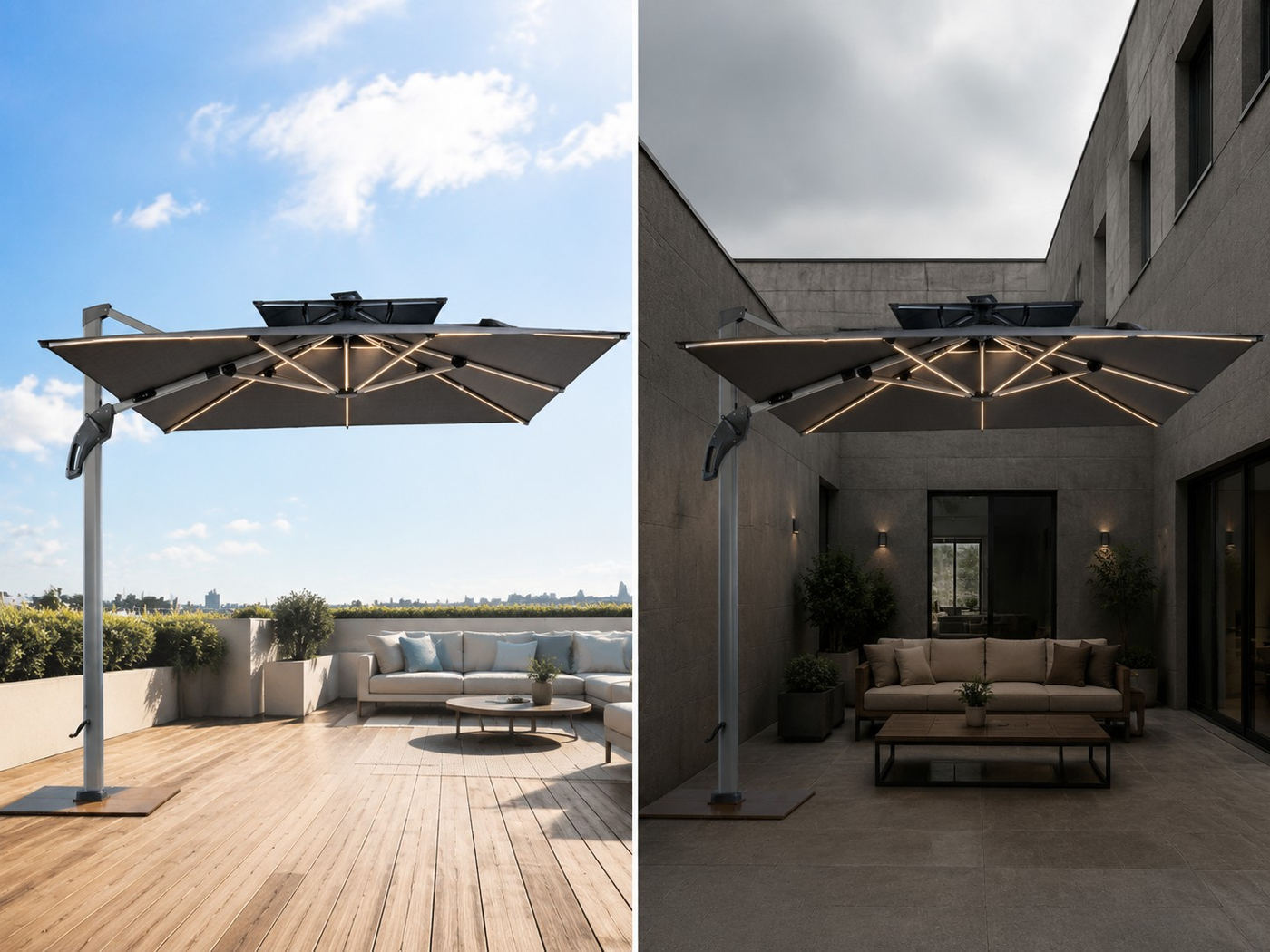
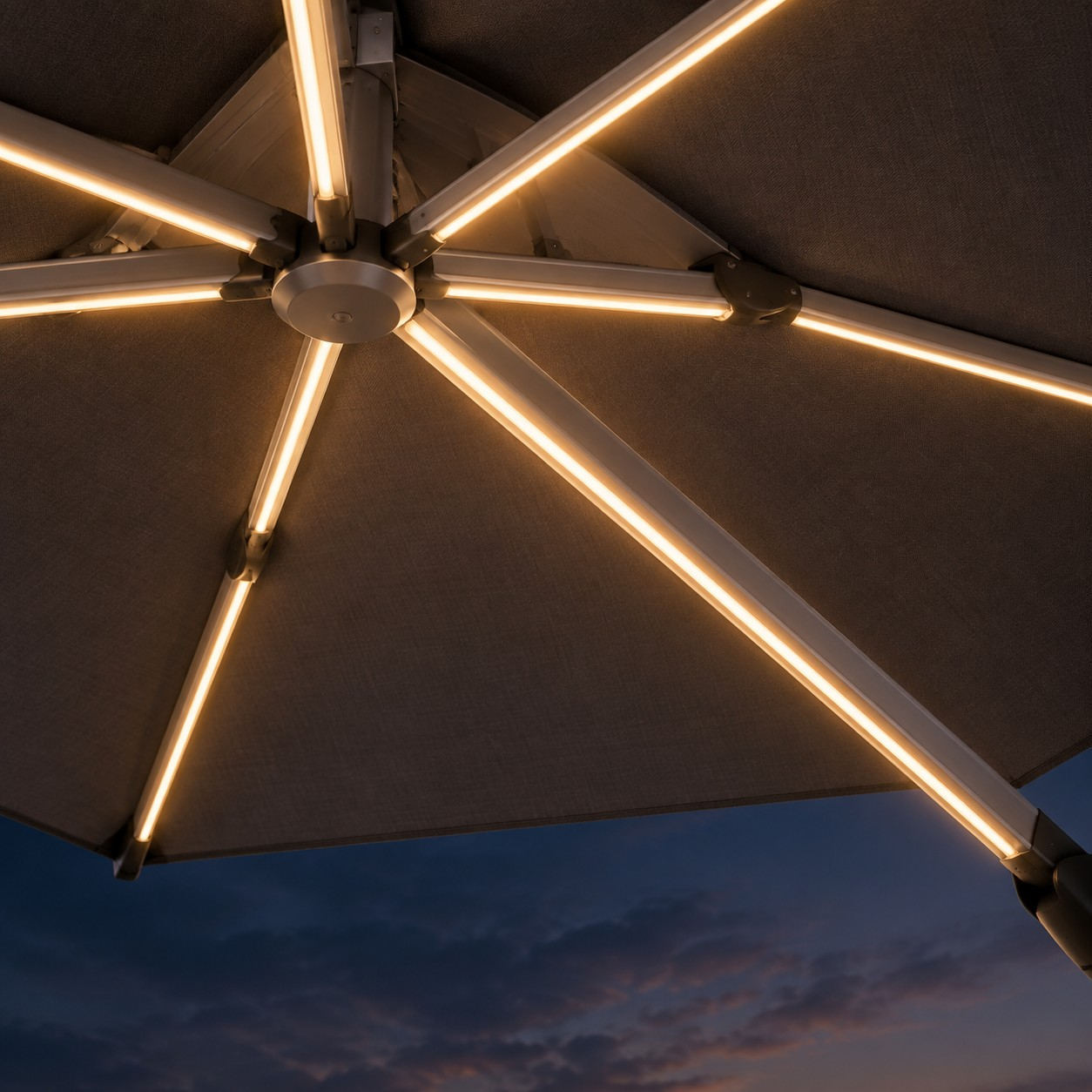
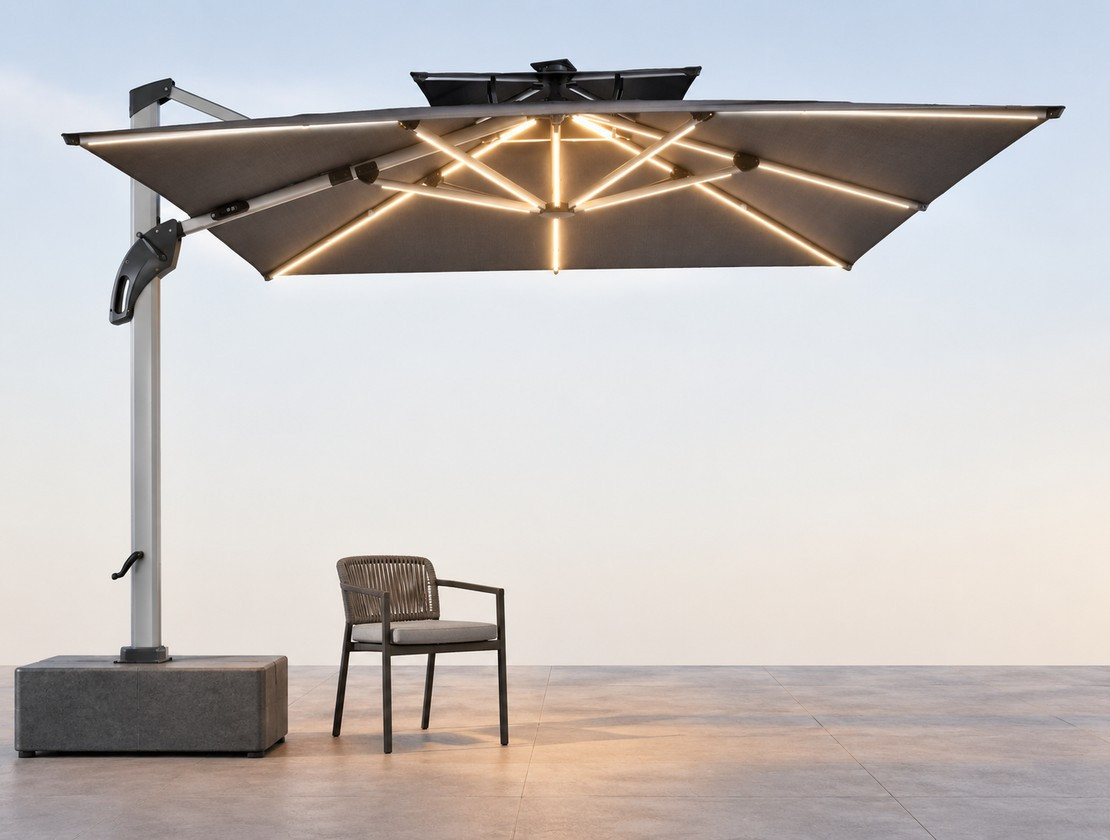
The lighting we fit is integrated into the ribs, not added on afterwards, and that single decision drives what the buyer notices a year later: light is spread along each rib rather than from one bright point, the wiring runs protected inside the frame, and nothing protrudes for a member of staff or a gust to catch. The alternative on the market is a bolt-on kit, usually a strip or a floodlight fixed to the pole or ribs after assembly, which is cheaper at sample stage and more expensive by the end of the second season. How the light sits inside the frame, and how each position is shown on the drawing before production, is set out on the LED outdoor umbrella range page.
Four decisions that set the lighting
Where the power comes from, where the light sits, how it is switched and how it is serviced. Work them in that order and the rest follows. All four are set out on our LED and lighting customisation page.
1. Choose the power source
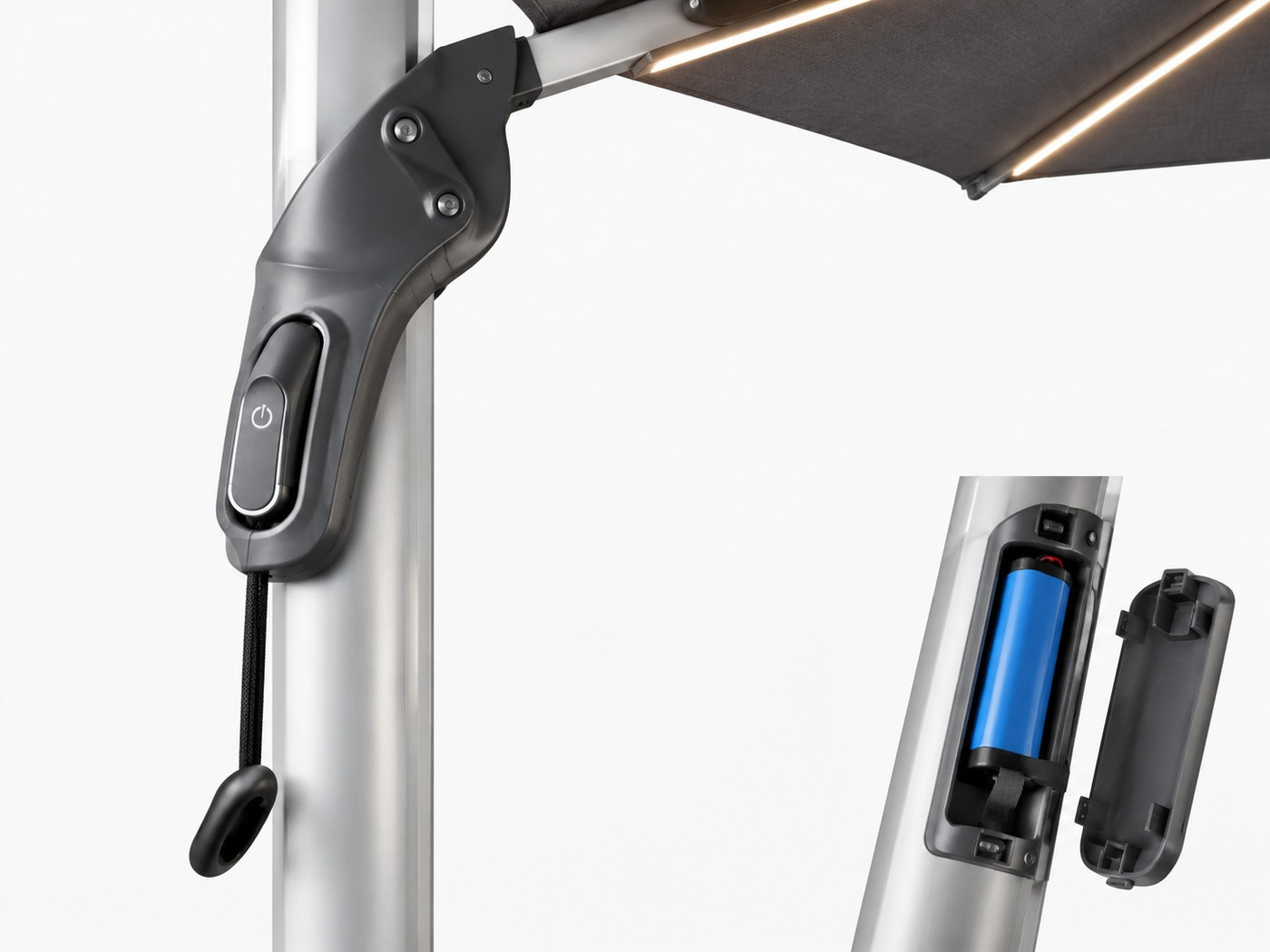
Solar suits open, sunny sites without a wiring route and is the cheapest to run, but it is also the option most often specified in the wrong place. Mains power suits shaded courtyards, indoor-adjacent terraces and cloudy regions. A rechargeable battery pack sits between the two: no wiring route needed, but a cell that is a consumable with a service routine. Decide it first, because this is the only one of the four where changing your mind later means re-wiring a terrace. Where the panel and the cell sit on a real unit is shown on our solar-powered cantilever with integrated LED ribs.
2. Decide where the light sits
Across the range the light sits in the ribs, and on some models the specification adds a second light at the centre. Ask for the lighting layout in the drawing, not just the wattage: what matters is the evenness of the light on the table and the absence of a bright spot in a guest's eyeline.
3. Set the control method
One clear control per umbrella beats a control panel with features nobody uses. Staff operate these units every evening, often in a hurry, sometimes in the rain. If the switch is not obvious, the light stays off.
4. Plan service and spares
Confirm battery replacement and spare parts before the rollout, not after the first season. A replaceable cell and a spare parts kit cost very little at order stage and decide whether the units are still lit in year three.
The frames that take lighting
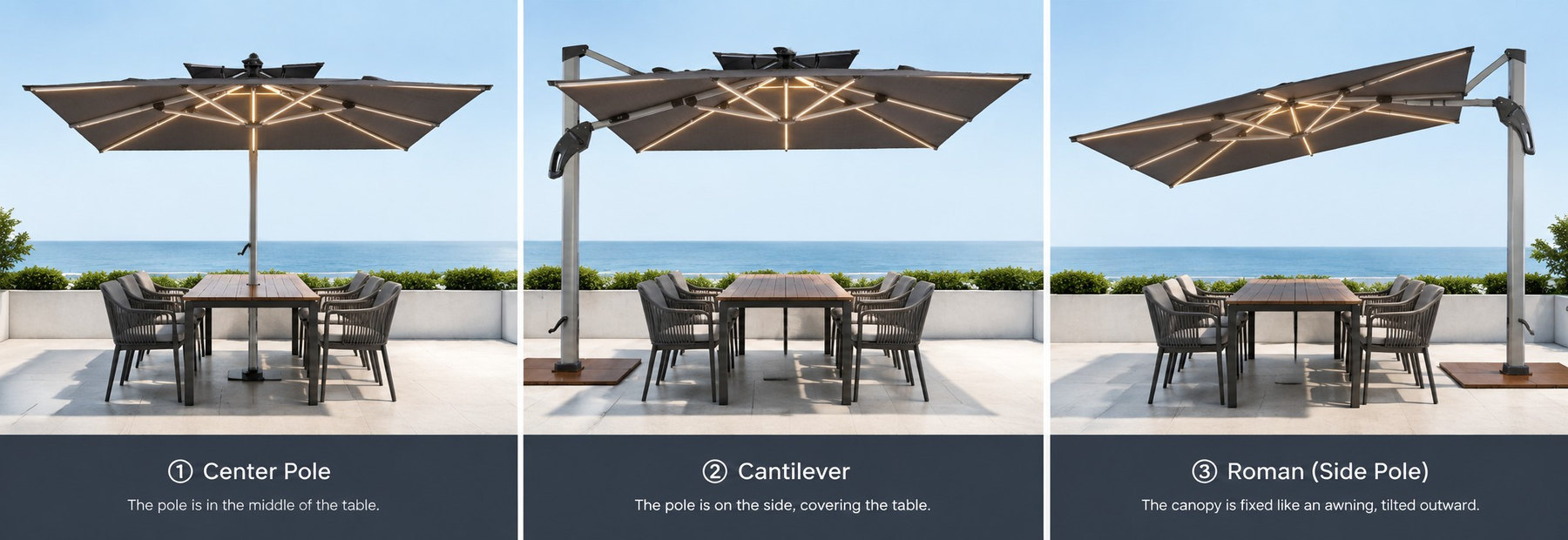
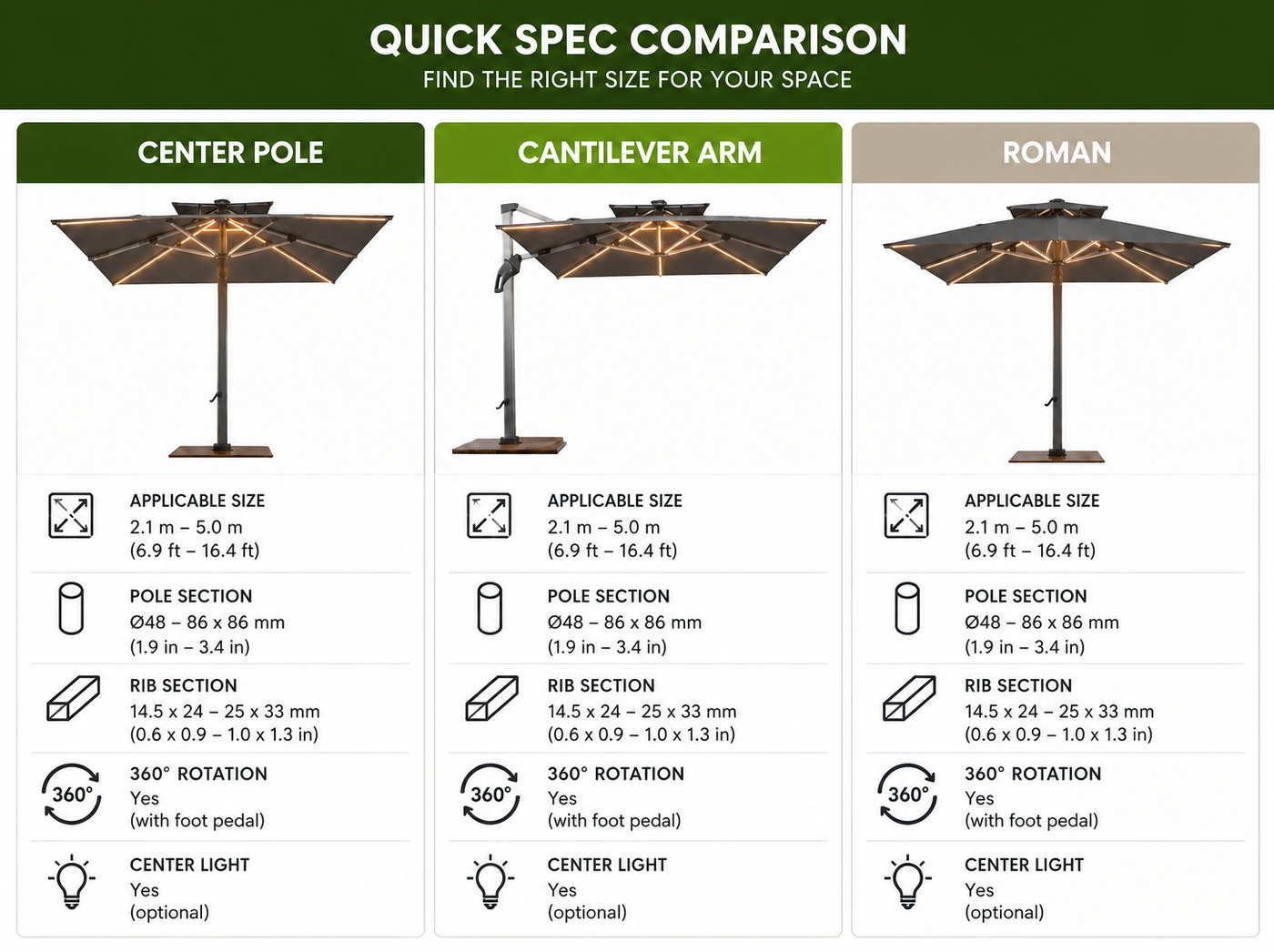
Lighting is available across all three structures we build, and the structure is usually decided by the terrace rather than by the light: centre pole keeps the footprint small, cantilever clears the seating area entirely, and Roman or side pole reads more like a fixed awning. What matters for comparison is the frame section, so we publish it for every version, from a 48 x 1.2 mm centre pole on a 3 m round up to 86 x 86 x 2.4 mm on a 5 x 5 m commercial frame, with ribs from 14.5 x 24 x 1.0 mm to 25 x 33 x 1.5 mm. The whole lit range is on the LED outdoor umbrella range page.
How the best-known shade brands approach light
Buyers comparing lit umbrellas usually arrive with a shortlist of well-known names. It is worth knowing what each is actually known for here, because the approaches genuinely differ.
- TUUCI treats illumination as part of the structure rather than an accessory. Its integrated LED lighting system is built into the umbrella and operated as one system, and on its larger cantilevers the lighting is specified alongside other automation such as heaters.
- Glatz approaches it from daily operation. The FORTELLO PRO runs dimmable LED from a rechargeable battery pack, published at up to ten hours of light, and the brand makes a point of there being no tangle of cables or electrical equipment for staff to manage.
- Treasure Garden covers the widest ground. LED is offered across its Starlux range, and the brand also sells add-on cordless lights such as the Halo and the Luna Pro, which mount into an umbrella and can therefore be retrofitted.
- FIM integrates LED into a sculptural designer parasol, where the light reads as part of the object rather than a fitting attached to it.
Two patterns are worth extracting. The first: the names with the strongest reputation in commercial shade tend to put the light inside the frame, and where a brand also sells an add-on light it is presented as an aftermarket option rather than the primary specification. The second: they differ on service. An integrated system with a replaceable cell is a different proposition over five years from a light that can be swapped in an afternoon.
Where Foris Hortus fits
We build the integrated approach into the middle of the market, for buyers who need a specified, serviceable lit umbrella rather than an architectural statement or a budget add-on.
- Light sits in the ribs across centre pole, cantilever and Roman frames, so there is nothing protruding for staff or wind to catch.
- Light colour, control method, battery service and IP protection are agreed together with the frame, before production.
- The cell is a replaceable component, not a sealed one, which is what keeps the units lit in year three.
- What we publish is the part most suppliers leave out: pole and rib sections, weight without base, container loading, MOQ and lead time, on every product page.
The full lit range is on the LED outdoor umbrella range page, and the specification decisions are set out on the LED and lighting customisation page.
Canopy, fabric and the light colour
Canopy fabric across the lit range is solution-dyed polyester with a PA or PU coating, 250 g to 300 g depending on the model, most of it rated UPF 50+. The heavier weights are specified on the larger commercial sizes where the canopy spans further between ribs.
Light colour is specified with the frame. Warm white is the default for hospitality because it sits with table lighting rather than fighting it. Whatever the choice, confirm it against the actual fabric colour: the same light reads differently through cream and through charcoal grey.
Sizing, weight and loading
A lit umbrella is a heavier umbrella, and the weight sits where the base is chosen. Plan the two together. On the commercial centre pole sizes, weight without base is 60 kg, 75 kg and 85 kg for 3 x 3 m, 4 x 4 m and 5 x 5 m respectively, and that is before the base that holds it down. The 3 x 3 m to 5 x 5 m commercial centre pole version, with the light in the ribs and a foot-pedal swivel, is published here.
If you are ordering from outside China, ask for the loading figures rather than estimating them. We publish container loading per version on the product pages, and our minimum order quantity is normally one 40 HQ container. On several lines the figure works out exactly to that, which is why the MOQ and the loading plan are the same conversation.
Six failures that show up in season two
The list is short and almost entirely predictable: solar specified on a shaded site, a sealed non-replaceable cell, an unsealed connector at the joint, no staff rule for storms, a base chosen for a smaller canopy, and branding left until after approval.
Five of the six are decided before production, and the pattern behind all six is the same: the lighting was treated as an accessory rather than as part of the frame. The full list, with the fix for each, is on the LED outdoor umbrella range page.
Wind: the limit lighting does not change
Lighting does not make an umbrella more wind-resistant, and a heavier base does not raise the canopy's own limit. Published wind resistance on our lit frames sits at Beaufort 4 to 5, size dependent, which is roughly 20 to 38 km/h. Above that the canopy comes down, lit or not.
That is the number to design the operating rule around. It is also the reason we publish it rather than implying that a bigger base solves wind: it does not.
Customisation: colour, printing and branding
Every lit line takes the same customisation as the rest of the range: canopy colour, fabric printing, a wood-grain frame finish where it suits the scheme, base type and finish, and logo placement on the canopy corners and valance. Frame colour and canopy specification are agreed under OEM and ODM against your project brief.
The MOQ for light customisation is usually 200 pieces and light customisation production runs 7 to 15 days. For a project rollout, the umbrella specification and the branding decision should be made in the same round as the frame approval.
Certifications, warranty and inspection
- ISO 9001 quality management system, FSC certified timber where wood is used, and EN 581-1 / 581-2 / 581-3 for outdoor furniture safety and durability.
- 12 month warranty from the date of loading, and third party inspection supported before shipment.
- After arrival you may appoint a professional third party within one month, and a production quality claim can be raised within three months with photographic or video evidence.
- Prices are quoted FOB Ningbo, with ex-works and CIF quotations available on request.
How to specify and order
- Send the terrace. Size, exposure, whether there is a power route, and the hours you want the terrace open.
- Choose the power source and the structure. Solar, mains or battery; centre pole, cantilever or Roman.
- Fix the canopy and the light colour against the fabric sample.
- Approve the frame finish and the branding in one round.
- Confirm the base, the loading plan and the delivery terms, then production, inspection and dispatch.
What happens after the purchase order
A lit order is easier to place than to track, and the difference between a calm rollout and a frantic one is usually whether the buyer knew what was happening at each stage. Every order is assigned a unique order number against the signed contract and tracked through seven published stages:
- Order confirmation. Sizes, light position, colour temperature and branding are locked. Lighting changes after this point are a new round of production.
- Production scheduling. Your unit enters the line; the date the schedule is set against is the one that matters for opening night.
- Material procurement. Frame sections, canopy fabric and the light modules are drawn for this order.
- Production process tracking. Frame welding and finishing, then the lighting and wiring.
- Quality control and inspection. This is the stage at which third party inspection is supported, before the units are packed, because it is the only point where a problem costs nothing to fix.
- Packaging and shipping. Export cartons and a loading plan; the loading figure for the version you ordered is the number to check here.
- Delivery and feedback. Arrival, unpacking, and the inspection window begins.
Two habits make this stage work for you rather than around you. First, ask for the drawing at confirmation, so light position and branding are approved on paper rather than discovered on arrival. Second, book your inspection for stage five rather than after the container lands, because at stage five the goods are still in our hands.
Reading a lighting specification
Most lighting specifications are written so they cannot be compared. These are the lines worth insisting on, and what each one actually decides.
IP rating, given separately for the light module and for the connector. A single "waterproof" claim tells you nothing. The two-digit rating is a pair of facts: the first digit is protection against solid objects and dust, the second against water. What matters in practice is that the module and the connector are rated separately, because the joint is where moisture gets in first. Ask for both numbers rather than an adjective.
Where the driver sits. The driver is the component that converts the supply into what the LEDs need, and its location decides how the umbrella is serviced. Inside the frame is tidy and protected but means the frame has to come apart; in the base or in a separate enclosure is easier to reach but adds a visible part. Whichever the answer, it should be a stated answer rather than something discovered during the first fault.
Whether it dims, and what the control is. Dimming is not a luxury in hospitality: it is how the terrace light is matched to the table light. Ask what the control is, where it is mounted, and whether one control covers one umbrella or a group.
Colour temperature in kelvin, not in words. "Warm" and "soft" are not specifications. A kelvin figure is. Warm white sits in the low range and reads closest to candlelight; neutral white is cooler and reads more like functional lighting. For a terrace with table lamps, the lower figure almost always sits better, and the number should be agreed at the sample stage rather than after delivery.
Runtime, quoted against brightness and pack age. A runtime figure without those two conditions is marketing. Light output falls as a pack drains, so ask what the figure refers to: full brightness, or the point at which output has already dropped. A cell also holds less over time, so the honest question is what the runtime is in year three, not on day one.
Battery chemistry, capacity and whether the cell is a standard part. The cell is the component that dies first. What matters commercially is whether a replacement is available as a normal spare, and whether it is a standard format rather than a proprietary pack that only the original supplier can provide. This single question decides whether the umbrella is still lit in year five.
What to ask for, line by line
A quotation you cannot compare is not a quotation. We ask for the following before quoting, and you can ask any supplier for the same list.
| What to ask for | Why it matters |
|---|---|
| Canopy size and structure | Decides the frame section, the weight and the base, not just the price |
| Site exposure and hours of use | A solar specification is a site decision; a shaded terrace needs a different answer |
| Whether a power route exists | Decides between solar, mains and battery pack |
| Light position and colour temperature | The visible result, and the line most often left vague |
| IP rating for module and connector | Tells you whether the joint survives a wet season |
| Whether the cell is replaceable and standard | The difference between a five-year unit and a three-year one |
| Loading figure for the version quoted | Conversion of the price into a landed cost |
| MOQ and production lead time | Whether the project schedule is realistic |
| Warranty terms and the inspection window | What happens when something is wrong on arrival |
| Spare modules and spare cells, priced | The line almost nobody quotes, and the one you will need |
Two habits are worth adopting. First, ask for the lighting as a separate line item from the frame, so that spare modules and cells have a known price. Second, ask for the loading figure for the exact version quoted, because a loading figure for a smaller canopy will make the landed cost look better than it is.
A specification sheet you can send to any supplier
If you are tendering, this is the shortest form that still produces comparable answers.
| Line | What to state |
|---|---|
| 1 | Terrace or site, with a photograph and the compass orientation |
| 2 | Canopy size required, and the number of covers under each umbrella |
| 3 | Structure: centre pole, cantilever or side pole |
| 4 | Installed or temporary; year-round or seasonal |
| 5 | Power available: none, an existing circuit, or trenching possible |
| 6 | Hours of use per evening, and the closing time |
| 7 | Light position: rib-integrated, hub, or undecided |
| 8 | Colour temperature, or the existing table lighting to match |
| 9 | IP rating required, stated for module and connector |
| 10 | Canopy colour and fabric, with a reference sample |
| 11 | Branding: canopy printing, corner or valance logo, frame marking |
| 12 | Delivery port, required date, and whether samples are needed first |
| 13 | Spare modules and cells required per site |
| 14 | Warranty and inspection requirements |
Send that sheet to three suppliers and the answers will be comparable, which is the whole point of tendering.
Spares and the five-year view
The frame and the canopy are the durable parts of a lit umbrella. The lighting is the part that needs attention, and the whole economics of a lit terrace turns on how easily that attention can be given.
- A replaceable light module means a failed strip is a maintenance task rather than a replacement umbrella.
- A replaceable, standard cell means a pack that has lost capacity is a consumable, not a write-off.
- Connector seals are cheap and should be listed as spares, because the joint is the first thing to suffer.
- A combined spare-parts list covering frames, fabric, lighting and fixings is worth asking for at order stage, while the order is still open.
Our warranty runs 12 months from the date of loading, and third party inspection is supported before shipment. After arrival you may appoint a professional third party within one month, and a production quality claim can be raised within three months with photographic or video evidence. Those windows are published because they define what to do if something is wrong, which is more useful than a longer warranty with no inspection route.
Commissioning and the staff routine
Most lighting faults we hear about are operating faults rather than manufacturing faults. Commissioning and a written staff routine prevent nearly all of them.
- Set out and fix the base before the frame is stood. Base selection follows the canopy size, not the price list.
- Open and close the frame a few times before fitting anything. Any stiffness will be obvious now and confusing later.
- Fit the lighting and test at full brightness, in the evening. Daylight hides a dim strip, and a strip that is dim on day one is a fault, not a setting.
- Confirm the charge behaviour on a solar unit over a full day before the terrace opens, not on opening night.
- Write the storm rule down. Above the published wind limit the canopy comes down and the power is isolated. Staff need that number, not an adjective.
A short routine carried out at closing keeps the lighting working: switch off at the handle rather than at the breaker, keep the fabric clear of the strip when closing, and clean the panel on a solar unit as part of the normal terrace clean. None of it takes long, and all of it is cheaper than a service call.
Eight questions that come up before a purchase order
What is your minimum order? Normally one 40 HQ container for a standard specification. For light customisation the usual minimum is 200 pieces.
Can the light be added after the frame is approved? No. Light colour, position, control and the IP requirement are agreed with the frame, because they change what gets produced. Treat lighting as part of the frame decision, not an accessory added later.
How long is production? Light customisation runs 7 to 15 days. For a full container of a standard specification, the schedule is confirmed against the order.
Is the lighting priced with the frame or separately? Ask for it separately. It makes spare modules and cells a known price rather than a negotiation after a failure.
Can lit and unlit versions share a container? Yes. Mixed loads are quoted per mix, so a project can fill a container with more than one item.
What documentation comes with the shipment? We publish the classification on the product pages: 9401719000 and 9401790000 for outdoor chairs, 9403899000 for outdoor tables and 9403700000 for plastic articles, with the place of origin stated as China (Zhejiang). Use them as a check against your own broker's advice rather than as a substitute for it.
What happens if the goods are wrong on arrival? Appoint a third party within one month of receipt. Production quality claims can be raised within three months with photographic or video evidence, and confirmed faults are returned to the factory with the freight covered by us.
How many spare modules should a site hold? For a terrace that runs year round, hold at least one spare light module and one spare cell per site, plus connector seals. For a multi-site rollout, agree a combined spare list rather than duplicating a kit at every site.
Terms used in this article
| Term | What it means here |
|---|---|
| IP rating | Two digits: protection against solids and dust, then against water. Ask for it separately for the module and the connector |
| Driver | The component that converts the supply into what the LEDs need. Its location decides how the unit is serviced |
| Lumen | A measure of light output. Useful only when quoted with the colour temperature and the running condition |
| Colour temperature | Light colour in kelvin. A lower figure is warmer and sits closer to candlelight |
| Runtime | Hours of light from one charge, and meaningless unless quoted against brightness and pack age |
| Replaceable module | A light strip that can be exchanged rather than the whole umbrella |
| MOQ | Minimum order quantity. On standard specifications this usually equals one container |
| FOB | Free on board. The price includes delivery to the named port; sea freight and insurance are on the buyer |
| 40 HQ | A 40 foot high cube container. Our loading figures are all quoted against this size |
| KD | Knock-down. Flat packed for transport, assembled on site, and it usually improves container loading |
The takeaways, in one place
- Power source is a site decision, not a product feature. Check the site before the specification.
- Rib-integrated light beats bolt-on kits in service, and you can see the difference by season two.
- A replaceable battery is worth more than a brighter one.
- Wind resistance is a property of the canopy, not of the base. We publish it, and we will not imply otherwise.
- MOQ, loading and lead time are known before you order, not discovered afterwards.
Tell us the terrace and the hours
Send the terrace dimensions, the site exposure, whether a power route exists, and how late you want the terrace usable. We will come back with a matched lighting specification, the loading figures for the sizes that fit, and a landed quotation.
Every product page carries the published frame sections and loading figures for that version.
Start a lighting enquiry and we will come back with the matched specification, the loading figures for the sizes that fit, and a landed quotation.
---
---